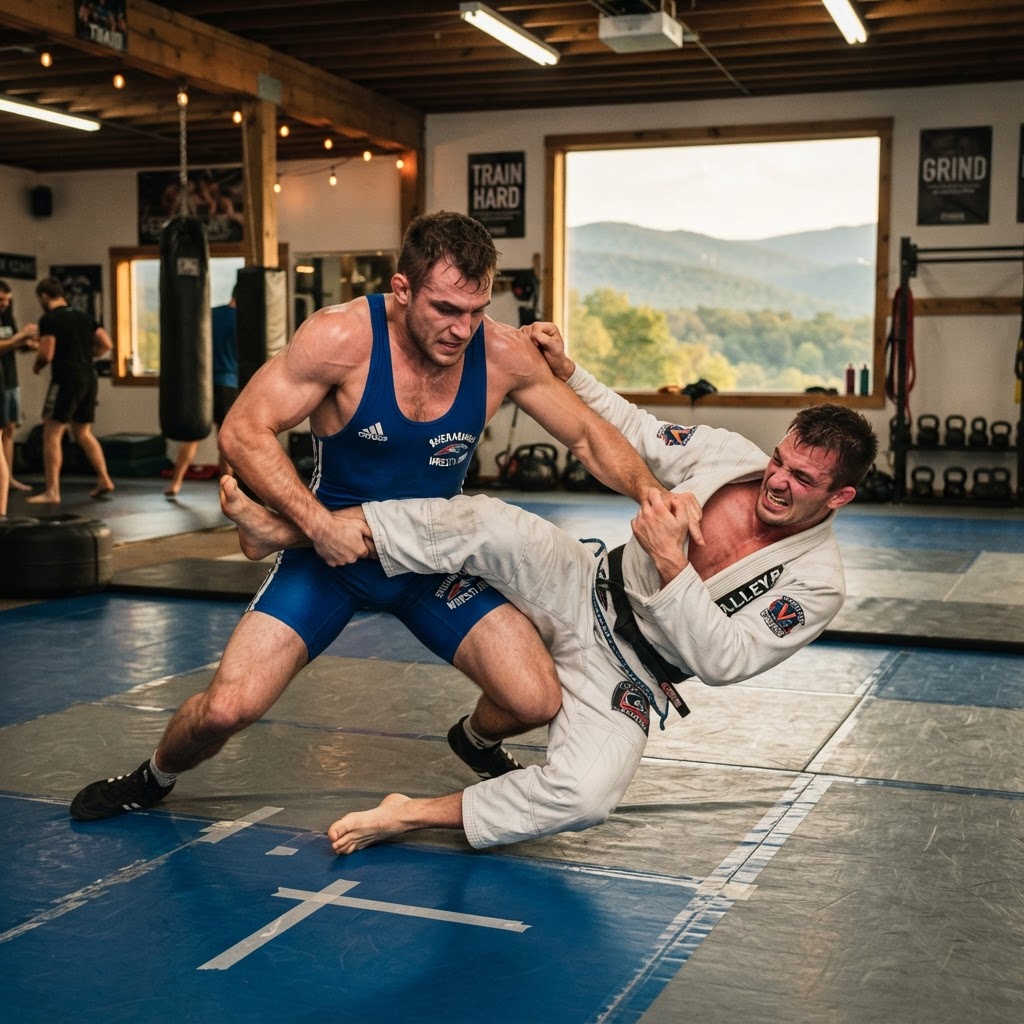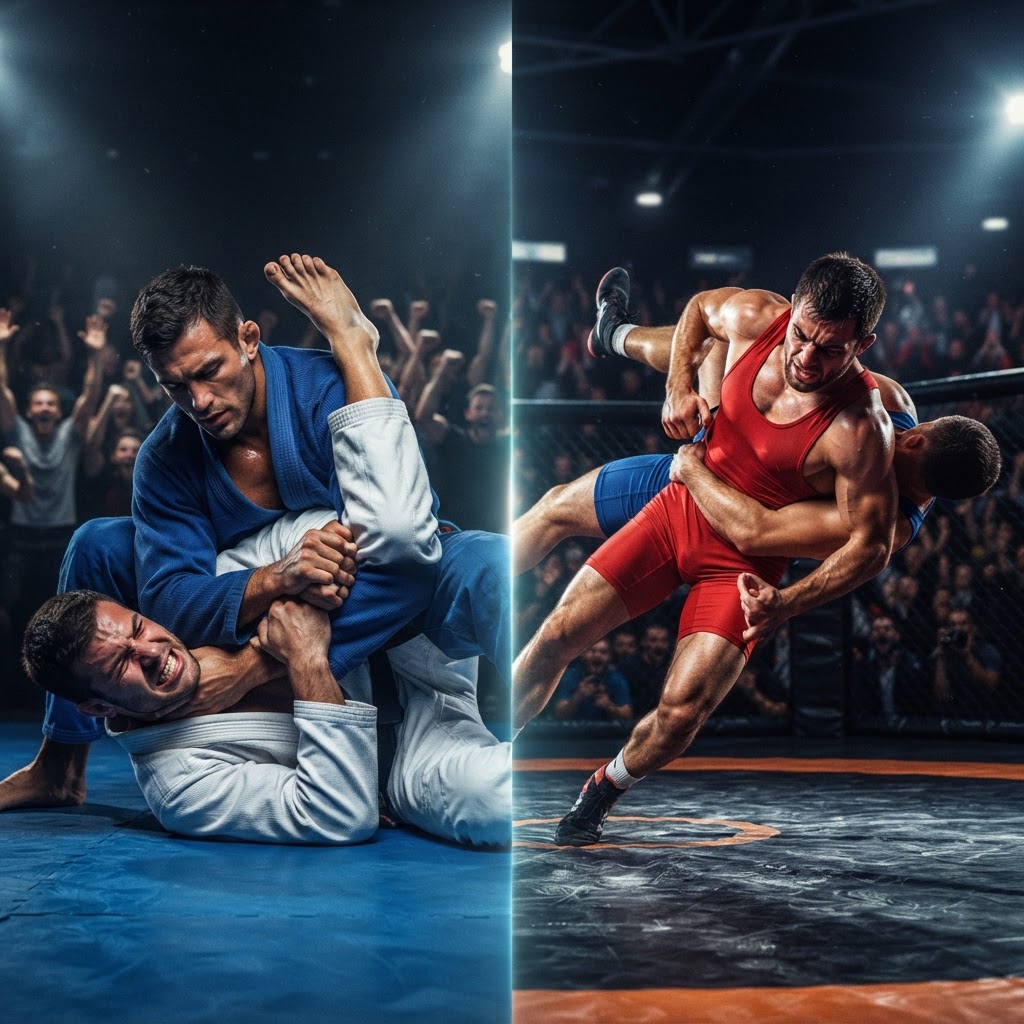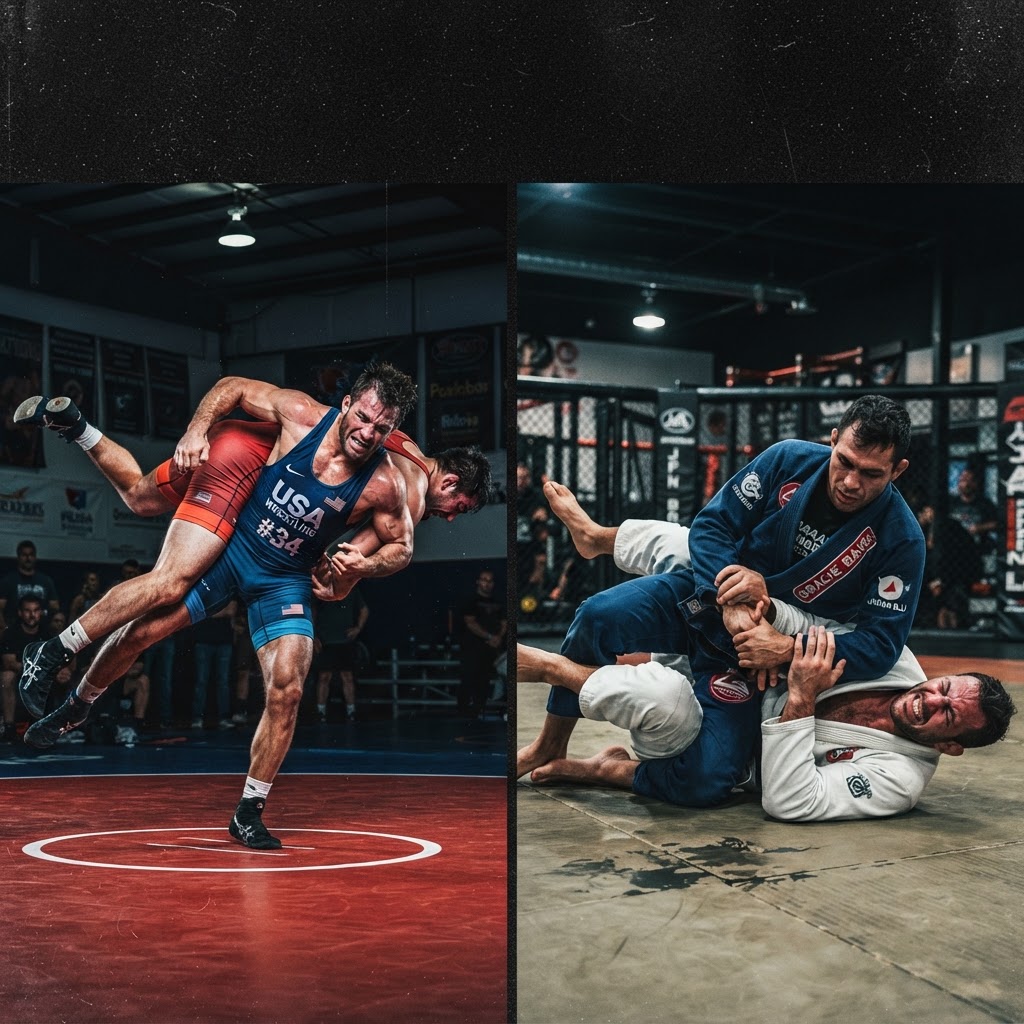
If you've ever wondered about wrestling vs BJJ for self defense, you're not alone. It's one of the most debated questions in the martial arts world, and for good reason. Both wrestling and Brazilian Jiu-Jitsu are grappling-based arts that teach you how to control an opponent without relying on strikes. But when it comes to a real-world self-defense scenario, the differences matter more than you might think.
Whether you're in Waynesboro, Charlottesville, Fishersville, or anywhere in the Shenandoah Valley, choosing the right martial art for personal protection is a serious decision. You need something that works when the stakes are real, when there are no referees, and when the ground beneath you is concrete instead of a cushy mat.
In this guide, we'll break down exactly how wrestling and BJJ compare for self-defense, where each art shines, where each falls short, and which one might be the better fit for your goals. Let's settle the debate.
Why Grappling Beats Striking for Self Defense
Before diving into the wrestling vs BJJ for self defense comparison, it's worth understanding why grappling arts in general are so effective for real-world protection. Most street altercations end up in a clinch or on the ground. Punches get thrown, someone grabs someone else, and before you know it, the fight has moved into close-quarters territory.
Grappling arts like Brazilian Jiu-Jitsu and wrestling excel in exactly this range. They teach you how to control an attacker, neutralize their offense, and either submit them or escape to safety. Striking arts like boxing or Muay Thai are valuable too, but they carry a higher risk of injury to your own hands and rely on distance management that can fall apart in a chaotic street encounter.
The core difference between BJJ and wrestling comes down to philosophy. Wrestling is about controlling position and pinning your opponent. BJJ is about controlling position and submitting your opponent. Both approaches can work for self-defense, but they lead to very different outcomes.
Wrestling for Self Defense: Strengths and Weaknesses
Wrestling is one of the oldest and most physically demanding combat sports on the planet. If you're asking is wrestling good for self defense, the short answer is yes, absolutely, but with some important caveats.
Where Wrestling Shines
Takedowns and takedown defense. Wrestling teaches you how to put someone on the ground and how to stay on your feet. In a self-defense situation, the person who controls whether the fight stays standing or goes to the ground has a massive advantage. A trained wrestler can slam an attacker to the pavement and control them from top position before they even know what happened.
Explosiveness and conditioning. Wrestlers are some of the best-conditioned athletes in any sport. The explosive power, grip strength, and cardiovascular endurance developed through wrestling translates directly to surviving a high-stress physical encounter. If you've ever wondered how wrestling improves your jiu-jitsu, the conditioning alone is a game-changer.
Scrambling ability. Wrestling teaches you to fight for position in chaotic, scrambling situations. Street fights are messy. The ability to stay calm and win positional battles when things go sideways is invaluable.
Top control. Once a wrestler gets you on your back, getting up is nearly impossible against someone who knows what they're doing. In a self-defense scenario, pinning an attacker and controlling them from the top can end a threat quickly.
Where Wrestling Falls Short
No submissions. Wrestling doesn't teach chokes or joint locks. A wrestler can control an attacker, but they can't force a tapout or render someone unconscious through a submission. To end a fight definitively without striking, you need submission skills, which is where BJJ excels.
No guard work. If a wrestler ends up on the bottom, they're in unfamiliar territory. Wrestling culture treats being on your back as losing. In a real fight, you might end up on the bottom against a larger attacker, and without guard skills, you're in trouble.
Habit of exposing your back. Wrestlers are trained to turtle up and give their back to avoid being pinned. In BJJ and in street fights, giving your back is one of the most dangerous things you can do. An attacker with any submission knowledge can choke you out from back control.
Go-go-go mentality. Wrestling is a sprint. Matches are short and intense. Street encounters can be unpredictable in duration. The wrestling instinct to go all-out for six minutes can lead to exhaustion if a situation drags on.
BJJ for Self Defense: Strengths and Weaknesses
Brazilian Jiu-Jitsu was specifically developed for real-world combat. The Gracie family designed it to allow a smaller, weaker person to defend against a larger, stronger attacker. When it comes to BJJ for street self defense, the art has a lot going for it.
Where BJJ Shines
Submissions that end fights. Chokes and joint locks can neutralize a threat decisively. A rear naked choke can render an attacker unconscious in seconds. An armbar can disable a limb. Unlike wrestling, BJJ gives you the tools to end a confrontation without throwing a single punch.
Fighting from your back. The guard is BJJ's signature position. If you end up on the ground with an attacker on top, BJJ teaches you how to defend, control, sweep, and submit from the bottom. This is critical, because in a real fight, you can't always dictate where you end up.
Size and strength neutralization. BJJ relies on leverage, angles, and technique rather than brute force. A skilled BJJ practitioner can defeat a much larger attacker by using proper technique. This is why BJJ is often recommended for women, smaller individuals, and anyone concerned about self-defense against a bigger opponent.
Distance management and clinch control. BJJ teaches how to close distance safely, clinch, and take the fight to the ground on your terms. The ability to enter without getting hit is a crucial self-defense skill.
De-escalation mindset. BJJ culture emphasizes control over damage. You can restrain an attacker without seriously injuring them, which is valuable from a legal and moral standpoint.
Where BJJ Falls Short
Takedown gaps. Sport BJJ has evolved to focus heavily on ground fighting, sometimes at the expense of takedown skills. Many BJJ schools pull guard in competition, which is a terrible idea in a street fight. If you can't take someone down or defend a takedown, your ground skills might never come into play. This is why wrestling takedowns for BJJ are so important to learn.
Multi-attacker vulnerability. Neither art handles multiple attackers well, but BJJ's preference for ground fighting can be especially risky. If you're on your back securing an armbar while a second attacker approaches, you're in serious danger.
Gi dependency. Some BJJ practitioners rely heavily on gi grips, which don't exist in a street fight where the attacker is wearing a t-shirt or no shirt at all. No-gi training is essential for self-defense application.
Guard pulling. The sport BJJ habit of pulling guard is one of the worst things you can do in a real fight. Going to your back voluntarily on concrete gives the attacker positional advantage and puts your head near the ground. If you train BJJ for self-defense, guard pulling should never be your go-to strategy.
READY TO TRY BRAZILIAN JIU-JITSU?
Claim a FREE trial class at Skyline Jiu-Jitsu today!
Serving Waynesboro, Charlottesville, Fishersville & the Shenandoah Valley
Wrestling vs BJJ for Self Defense: Head-to-Head Comparison
So how do they stack up in the key categories that matter for self-defense? Let's break it down.
1. Takedowns: Wrestling Wins
Wrestling is the gold standard for takedowns. Double-legs, single-legs, and body locks are proven, reliable ways to put someone on the ground. BJJ has takedowns too, but they're generally less refined unless the practitioner has cross-trained in wrestling or judo. If your goal is to dictate whether the fight stays standing or goes to the ground, wrestling gives you the edge.
2. Finishing the Fight: BJJ Wins
Wrestling can put someone down and control them, but BJJ can end the fight. Chokes and joint locks are fight-enders. A wrestler can pin an attacker, but the attacker is still conscious and can still strike, bite, or reach for a weapon. A BJJ practitioner can apply a choke and render the attacker unconscious, eliminating the threat entirely.
3. Defending From the Bottom: BJJ Wins
If you end up on your back, BJJ is your best friend. The guard, sweeps, and submission attacks from the bottom are unique to BJJ and can turn a bad situation around. A wrestler on their back is like a fish out of water.
4. Conditioning and toughness: Wrestling Wins
Nothing builds grit quite like wrestling. The training intensity, weight cutting, and physical punishment of wrestling create athletes who are mentally and physically tough. BJJ practitioners get in great shape too, especially when they ask is jiu jitsu a good workout, but wrestling's conditioning is on another level.
5. Real-World Application: BJJ Wins (With Caveats)
Brazilian Jiu-Jitsu was designed for real combat. The self-defense curriculum in BJJ addresses common street attack scenarios, including defending headlocks, guillotine chokes, grabs, and tackles. Wrestling's sport rules don't account for strikes, weapons, or the unpredictability of street violence. However, BJJ's sport evolution has drifted from its self-defense roots in many schools, so it matters which BJJ academy you train at.
The Best Answer: Train Both
Here's the truth: the best grappling art for self-defense isn't wrestling or BJJ. It's both. Crossover athletes who train both develop the most well-rounded skill set for real-world protection.
Wrestling gives you takedowns, takedown defense, top control, and conditioning. BJJ gives you submissions, guard work, escapes, and the ability to finish a fight from any position. Together, they create a grappler who can dictate where the fight goes, control the attacker, and end the threat decisively.
This is why so many MMA fighters have a wrestling base supplemented by BJJ. The combination is simply devastating. If you're serious about self-defense, consider cross-training. Learn wrestling principles to improve your BJJ, and use BJJ submissions to complement your wrestling takedowns.
Self Defense in Waynesboro, VA: Why Local Training Matters
If you live in Waynesboro, Charlottesville, Fishersville, or anywhere in the Shenandoah Valley, you have access to quality BJJ training right in your backyard. Training locally matters because self-defense skills perish without regular practice. You need live sparring, real partners, and coaching in person.
At Skyline Jiu-Jitsu in Waynesboro, Virginia, we incorporate wrestling takedowns and positional control into our BJJ curriculum. You don't have to choose between the two arts. Our program blends the best of both worlds so you develop a complete grappling skill set that works in competition and on the street.
For those looking specifically for self-defense training, self-defense classes in Waynesboro offer practical, hands-on instruction that builds real confidence. And if you're a parent wondering about your kids, kids self-defense through BJJ is one of the safest and most effective options available.
Key Takeaways: Wrestling vs BJJ for Self Defense
- Wrestling excels at takedowns, takedown defense, top control, explosiveness, and scrambling. It's ideal for dictating where a fight goes.
- BJJ excels at submissions, guard work, bottom defense, size neutralization, and finishing a fight without striking.
- Wrestling's biggest weakness for self-defense is the lack of submissions and the danger of exposing your back.
- BJJ's biggest weakness for self-defense is takedown gaps and the sport habit of guard pulling.
- The best approach is to train both: wrestling takedowns plus BJJ submissions equals a complete self-defense skill set.
- Local training in the Shenandoah Valley gives you regular live practice, coaching, and real partners to sharpen your skills.
Frequently Asked Questions
Is wrestling or BJJ better for self defense?
Brazilian Jiu-Jitsu is generally considered more effective for self-defense because it teaches submissions that can end a fight, guard work for defending from the bottom, and techniques that work against larger attackers. However, wrestling provides superior takedown and takedown defense skills that are essential for controlling where a real fight takes place. The best approach is to train both.
Can a wrestler beat a BJJ practitioner in a street fight?
It depends. A wrestler has the advantage in takedowns and top control, while a BJJ practitioner has the advantage in submissions and bottom game. If the wrestler can avoid submissions and keep top position, they can win by control. If the BJJ practitioner can apply a choke or sweep, they can finish the fight. In general, a BJJ practitioner with wrestling cross-training has the edge.
Does BJJ work in a street fight?
Yes, BJJ works in street fights when trained properly. The key is to focus on self-defense-oriented BJJ rather than sport BJJ. Avoid pulling guard, train no-gi, and learn takedowns. BJJ submissions like chokes are highly effective for neutralizing a threat without causing permanent injury.
How long does it take to learn BJJ for self defense?
You can develop basic self-defense skills in BJJ within 3-6 months of consistent training. However, proficiency that you can rely on under pressure typically takes 1-2 years. The beauty of BJJ is that even a few months of training gives you a significant advantage over an untrained attacker.
Related Posts
- BJJ vs Wrestling: Key Differences, Rules, and Which Martial Art Is Right for You
- Wrestling for BJJ: 7 Ways Wrestling Improves Your Brazilian Jiu-Jitsu
- Wrestling Takedowns for BJJ: 7 Stand-Up Skills Every Grappler Should Learn
- From the Mat to the Mats: How to Transition From Wrestling to BJJ Successfully
- BJJ for Wrestlers: Why Crossover Athletes Have the Ultimate Advantage
- Self Defense Classes Near Me: Why BJJ Is the Best Choice in Waynesboro, VA
READY TO TRY BRAZILIAN JIU-JITSU?
Claim a FREE trial class at Skyline Jiu-Jitsu today!
Serving Waynesboro, Charlottesville, Fishersville & the Shenandoah Valley