BJJ vs Wrestling: Which Grappling Style Should You Choose?
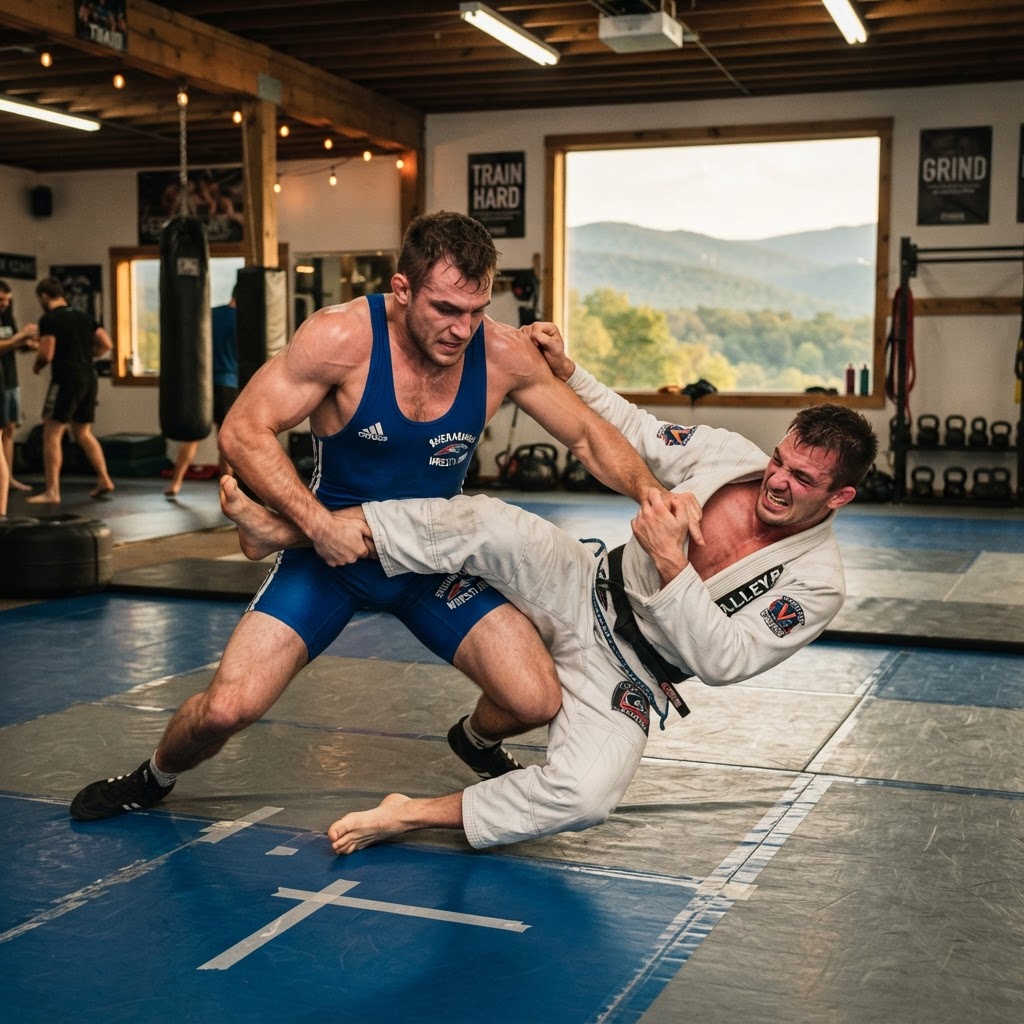
If you are exploring grappling martial arts, you have probably found yourself weighing BJJ vs wrestling. Both are incredibly effective, both build serious athletes, and both teach you how to control another human being on the ground. But they approach the fight game in fundamentally different ways. Whether you are in Waynesboro, Charlottesville, Fishersville, or anywhere in the Shenandoah Valley, understanding the difference between Brazilian Jiu-Jitsu and wrestling will help you make the right choice for your goals, your body, and your schedule.
In this guide, we break down everything you need to know about BJJ vs wrestling: the rules, the techniques, the physical demands, the learning curve, and which style makes the most sense depending on what you want to accomplish. By the end, you will have a clear picture of which grappling path is right for you.
Understanding the Two Styles: What Is BJJ and What Is Wrestling?
Before we dive into the comparison, let us define what each art actually is.
Brazilian Jiu-Jitsu (BJJ)
Brazilian Jiu-Jitsu is a grappling martial art that evolved from Japanese Judo and traditional Jiu-Jitsu, refined in Brazil by the Gracie family. The core philosophy of BJJ is that a smaller, weaker person can successfully defend themselves against a larger, stronger opponent by using leverage, technique, and submission holds. BJJ focuses heavily on ground fighting, including positions like guard, mount, side control, and back control, along with submissions such as armbars, triangle chokes, and rear naked chokes.
BJJ is practiced both in the gi (the traditional uniform) and in no-gi (rashguards and shorts). To learn more about that distinction, check out our guide on gi vs no-gi BJJ.
Wrestling
Wrestling is one of the oldest combat sports in human history, with roots stretching back to ancient civilizations. Modern wrestling encompasses several styles, including freestyle, Greco-Roman, and folkstyle (the style practiced in American high schools and colleges). Wrestling focuses on takedowns, throws, positional control, and pinning. Unlike BJJ, wrestling does not include submission holds. The goal is to take your opponent to the mat and control them, ideally pinning their shoulders to the ground.
Wrestling is notorious for its intense conditioning demands and explosive power. It builds athletes who are physically dominant, mentally tough, and relentless in their pressure.
BJJ vs Wrestling: The Key Differences
Now let us get into the heart of the wrestling vs BJJ differences that matter most when you are deciding which to train.
1. Objective and Rules
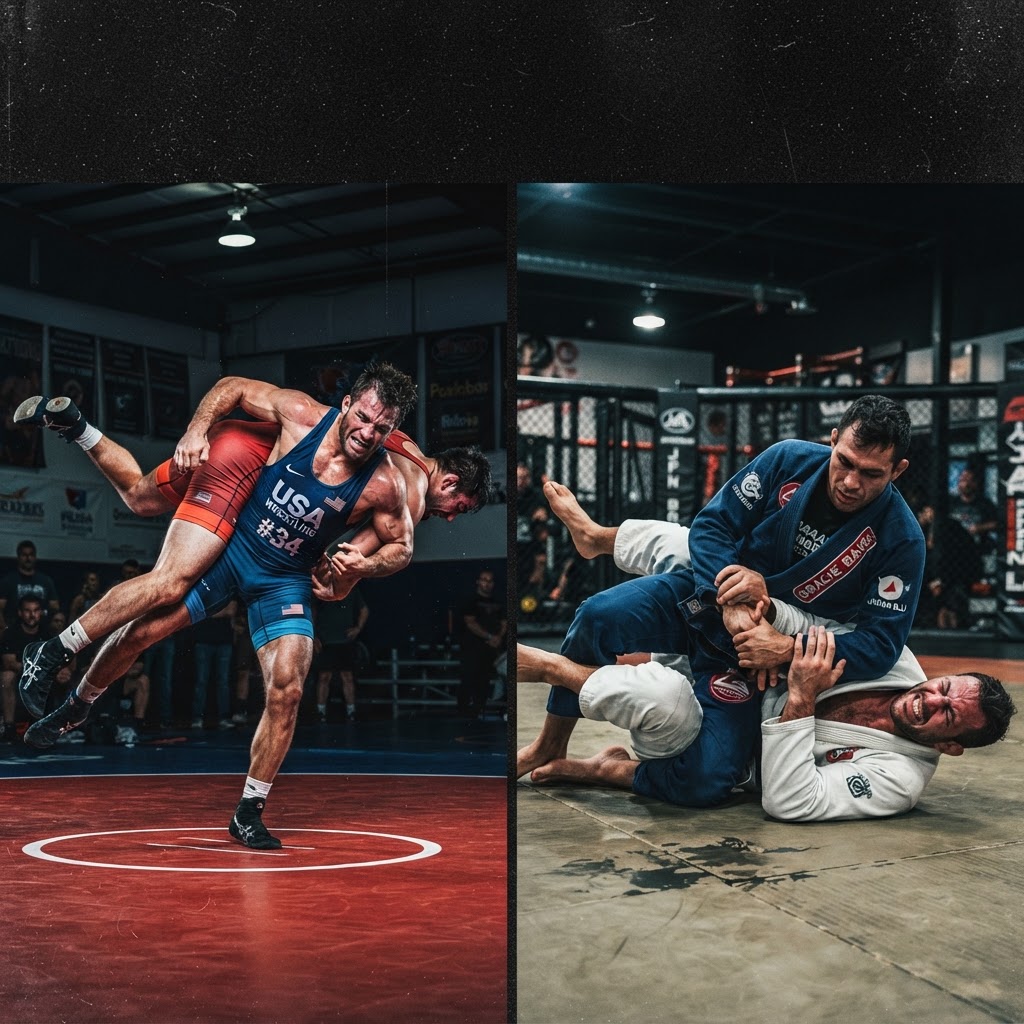
The most obvious difference is the win condition. In wrestling, you win by pinning your opponent's shoulders to the mat or by accumulating points through takedowns and escapes. In BJJ, you win by submitting your opponent with a choke or joint lock, or by accumulating points through positional advancement.
This difference in objective shapes everything. A wrestler is trying to flatten and pin. A BJJ practitioner is trying to submit. A wrestler's dream position (opponent flat on their back) is actually a vulnerable position in BJJ if the person on top does not know how to defend submissions. Conversely, a BJJ player's preferred position (pulling guard) would never happen in a wrestling match.
2. Where the Fight Happens
Wrestling is primarily a standing and top-position game. The action starts on the feet, and the wrestler works to take the opponent down and keep them there. Wrestling has almost no bottom-game techniques beyond escapes and reversals.
BJJ, on the other hand, has an incredibly sophisticated bottom game. The guard position, where you are on your back with your legs controlling your opponent, is uniquely BJJ. A BJJ practitioner can attack from the bottom just as effectively as from the top, which is something wrestling simply does not teach.
3. Submissions vs Pins
This is perhaps the most important distinction in the BJJ vs wrestling debate. Wrestling ends when shoulders touch the mat. BJJ ends when someone taps. Submissions, chokes, and joint locks are the bread and butter of BJJ. Wrestling has none of these.
For self-defense purposes, this matters. A pin does not end a street fight. A choke or joint lock does. That said, wrestling's takedown skills are arguably more important for self-defense than BJJ's ground techniques, because controlling whether the fight goes to the ground at all is a massive advantage. We explore this in depth in our article on wrestling vs BJJ for self defense.
4. Conditioning and Physical Demands
Both sports are physically demanding, but in different ways. Wrestling is widely considered one of the most conditioning-intensive sports on the planet. The explosive power, the constant scrambling, and the grind of maintaining top position require an extraordinary level of cardiovascular fitness and muscular endurance.
BJJ is also a tremendous workout, but it is more technical and less explosive by nature. BJJ allows you to use leverage and technique to conserve energy, which is why you will see 50-year-old BJJ practitioners rolling hard while wrestling tends to be a younger athlete's game. That said, competitive BJJ at high levels is extremely physically demanding.
If fitness is your primary goal, both deliver. Check out our guide on whether BJJ gets you in shape for more on the fitness side of jiu-jitsu.
5. Learning Curve
Wrestling has a steeper initial learning curve because the techniques require explosive athleticism and the culture is notoriously intense. Beginners in wrestling are thrown into the fire quickly.
BJJ has a gentler on-ramp. Most BJJ academies, including ours in Waynesboro, have dedicated beginner programs that teach fundamentals in a controlled, supportive environment. You can start BJJ with zero athletic background and progress safely. For more on starting out, read our BJJ for beginners guide.
6. Age and Longevity
Wrestling is a young athlete's sport. The explosive movements, the impact of takedowns, and the intense weight cutting take a toll over time. Most competitive wrestlers peak in their late teens to mid-20s.
BJJ is famously a lifelong martial art. People start BJJ in their 30s, 40s, 50s, and beyond, and they progress and compete at their own pace. The technical nature of BJJ means that skill can compensate for declining athleticism. This makes BJJ the more accessible option for adults in the Shenandoah Valley who want a martial art they can practice for decades.
BJJ vs Wrestling for MMA: Which Gives You the Edge?
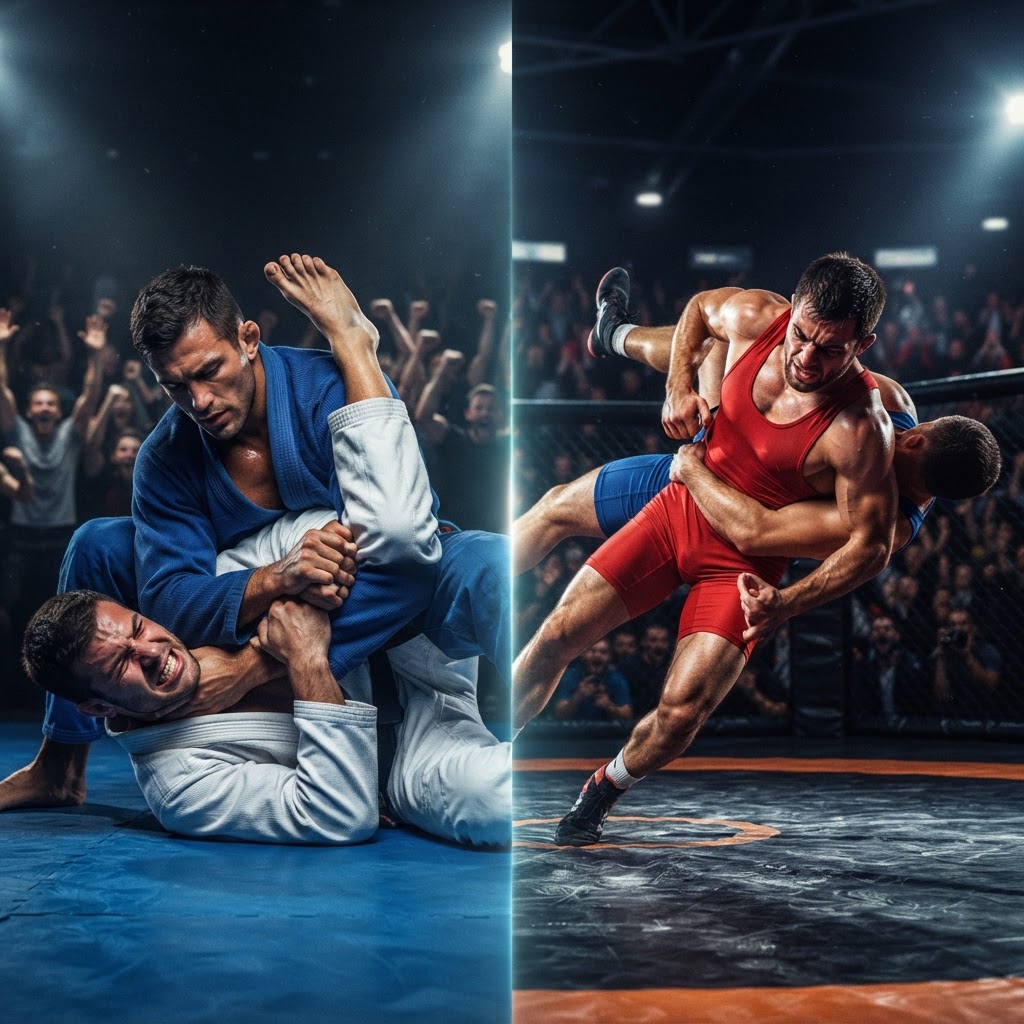
If your goal is mixed martial arts, the BJJ vs wrestling for MMA question is a critical one. The short answer is that you need both, but they serve different purposes.
Wrestling is often called the best base for MMA, and for good reason. Wrestlers dictate where the fight takes place. They decide whether the fight stays standing or goes to the ground. This is an enormous advantage in MMA. Many of the most dominant UFC champions, from Daniel Cormier to Khabib Nurmagomedov, have wrestling backgrounds.
BJJ brings the finishing skills. Once the fight is on the ground, BJJ provides the submissions and the defensive awareness to avoid getting caught. A wrestler with no BJJ training is vulnerable to submissions on the ground, while a BJJ player with no wrestling training may struggle to get the fight where they want it.
READY TO TRY BRAZILIAN JIU-JITSU?
Claim a FREE trial class at Skyline Jiu-Jitsu today!
Serving Waynesboro, Charlottesville, Fishersville & the Shenandoah Valley
The best MMA fighters blend both. If you are in Waynesboro or Charlottesville and dreaming of fighting, starting with BJJ and supplementing with wrestling takedowns is an excellent path. Our guide on wrestling takedowns for BJJ covers the specific takedown skills every grappler should learn.
The Best Grappling Martial Art for Different Goals
Let us break down which style is best depending on what you want to achieve.
For Self-Defense: BJJ Wins, but Wrestling Helps
BJJ is generally considered the better best grappling martial art for self-defense because submissions end fights definitively. A rear naked choke will neutralize any attacker, regardless of size. BJJ also teaches you how to survive bad positions and escape from underneath a larger opponent.
However, wrestling's takedown defense is arguably the most important self-defense skill of all. If you can stay on your feet, you can run. If you get taken down and cannot get back up, you are in trouble. This is why many self-defense experts recommend learning both.
For Fitness: Both Are Excellent
Wrestling will build explosive power, cardiovascular endurance, and full-body strength like few other activities. BJJ will build functional strength, flexibility, core stability, and endurance, all while teaching you a valuable skill.
For most adults in the Shenandoah Valley, BJJ is the more sustainable fitness path. You can train BJJ three to four times per week well into your 50s and 60s. Wrestling at that frequency is much harder on the body.
For Kids: BJJ Is More Accessible
Both sports are excellent for children, but BJJ is generally more accessible for kids who do not have a wrestling program at their school. BJJ teaches self-defense, discipline, confidence, and problem-solving in a safe, structured environment. Wrestling is fantastic for kids who have access to a school team, but BJJ academies are available year-round.
If you are a parent in Waynesboro or Fishersville, BJJ offers a year-round program that builds character and self-defense skills. Learn more in our guide on the best martial arts for kids.
For Competition: Both Have Robust Tournament Scenes
Wrestling has a well-established competitive pipeline through schools, clubs, and national tournaments. BJJ has an equally vibrant competition scene with IBJJF, NAGA, ADCC, and local tournaments held throughout Virginia and the broader Mid-Atlantic region.
BJJ competitions are more accessible for adults because they offer divisions by age, weight, and belt level. You can compete as a white belt in your first year of training. Wrestling competitions for adults are less common outside of college and Olympic pipelines.
Why Crossover Athletes Have an Advantage
Athletes who have trained both wrestling and BJJ are some of the most dangerous grapplers on the planet. Wrestlers who learn BJJ submissions become nearly unstoppable on the ground. BJJ players who learn wrestling takedowns become complete grapplers who can dictate where every match goes.
If you already have a wrestling background, you have an enormous head start in BJJ. Your conditioning, your scrambling ability, and your top pressure will translate immediately. What you need to learn is the submission game and the guard system. Our article on BJJ for wrestlers breaks down exactly why crossover athletes have the ultimate advantage.
And if you are a BJJ practitioner looking to add wrestling to your game, even a few months of wrestling takedown practice will dramatically improve your stand-up game. Check out our guide on wrestling for BJJ for specific ways wrestling improves your jiu-jitsu.
Training in the Shenandoah Valley: Your Local Options
If you are in Waynesboro, Charlottesville, Fishersville, Staunton, or anywhere in the Shenandoah Valley, your options for wrestling and BJJ training look different.
Wrestling is primarily available through school programs. If you are a student, your middle school or high school likely has a wrestling team. For adults, finding a dedicated wrestling program is much harder. Most adult wrestling instruction happens through BJJ academies that offer no-gi grappling classes with a wrestling focus.
BJJ, on the other hand, is available year-round for all ages. Skyline Jiu-Jitsu in Waynesboro offers BJJ classes for kids, teens, and adults, from absolute beginners to advanced practitioners. Whether you want to learn self-defense, get in shape, compete, or simply try something new, BJJ provides a structured path with clear milestones through the belt system.
You can see our full class schedule at skylinejiujitsu.com/schedule and pricing details at skylinejiujitsu.com/pricing.
So, Which Should You Choose: BJJ or Wrestling?
Here is our honest recommendation for the BJJ vs wrestling decision:
Choose BJJ if: you are an adult looking for a martial art you can practice long-term, you want self-defense skills, you want a supportive community, you want to compete at your own level, or you want a sustainable fitness routine that challenges both body and mind.
Choose wrestling if: you are a student with access to a school team, you want to build explosive athletic power, you are interested in MMA and need takedown skills, or you thrive in high-intensity, competitive environments.
Choose both if: you want to be a complete grappler. Start with BJJ for the foundation, and add wrestling takedowns as you progress. This is the path that produces the most well-rounded grapplers.
For most adults in Waynesboro and the surrounding Shenandoah Valley, BJJ is the more practical, accessible, and sustainable choice. You can start at any age, any fitness level, and progress at your own pace while building real skills that could save your life.
Related Posts
- Wrestling vs BJJ for Self Defense: Which Grappling Art Actually Works in a Real Fight?
- BJJ for Wrestlers: Why Crossover Athletes Have the Ultimate Advantage on the Mat
- From the Mat to the Mats: How to Transition From Wrestling to BJJ Successfully
- Wrestling Takedowns for BJJ: 7 Stand-Up Skills Every Grappler Should Learn
- Wrestling for BJJ: 7 Ways Wrestling Improves Your Brazilian Jiu-Jitsu
- BJJ for Beginners: How to Survive Your First Month of Training
READY TO TRY BRAZILIAN JIU-JITSU?
Claim a FREE trial class at Skyline Jiu-Jitsu today!
Serving Waynesboro, Charlottesville, Fishersville & the Shenandoah Valley