Essential BJJ Submissions Every Grappler Should Know: A Complete Guide
If you're training BJJ submissions in Waynesboro, Charlottesville, or anywhere in the Shenandoah Valley, you already know that the art of submission is what makes Brazilian Jiu-Jitsu one of the most effective martial arts on the planet. Unlike striking arts that rely on punches and kicks, BJJ is built on the principle that a smaller, weaker person can defeat a larger opponent by using leverage, technique, and well-timed submissions. Whether you're a white belt just starting out or a seasoned grappler refining your game, understanding the core submissions is essential to your progress on the mats.
In this complete guide to BJJ submissions for beginners and experienced practitioners alike, we'll break down the most important submission techniques in Brazilian Jiu-Jitsu — how they work, when to apply them, and how to drill them effectively. If you're new to the art, check out our guide on what Brazilian Jiu-Jitsu is and our tips for surviving your first month of training before diving in.
What Is a BJJ Submission?
A submission in Brazilian Jiu-Jitsu is a technique applied to force your opponent to "tap out" — signaling surrender before injury occurs. Submissions generally fall into two categories: chokes (strangulations) that cut off blood flow or air supply to the brain, and joint locks that apply painful, potentially damaging pressure to joints like the elbow, shoulder, knee, or ankle. The beauty of BJJ is that these Brazilian jiu jitsu techniques rely on biomechanics and leverage rather than brute strength, making them accessible to practitioners of all sizes and ages.
For students training at academies across Fishersville, Waynesboro, and the greater Shenandoah Valley, learning submissions is a gradual process. You won't learn them all on day one. Instead, your instructor will introduce fundamental submissions during your foundational positional training, building your understanding layer by layer.
The 7 Most Essential BJJ Submissions
1. Rear Naked Choke (Mata Leão)
The rear naked choke — also known as "Mata Leão" or "Lion Killer" in Portuguese — is arguably the most important submission in all of Brazilian Jiu-Jitsu. Applied from back control, this choke uses the attacker's arms to form a figure-four around the opponent's neck, compressing the carotid arteries on both sides to cut off blood flow to the brain. When applied correctly, the rear naked choke can render an opponent unconscious in under 10 seconds.
What makes the RNC so essential is that it works at every level — from white belt to world champion. It doesn't require strength, it's difficult to defend once secured, and it's one of the highest-percentage submissions in both competition and self-defense situations. At Skyline Jiu-Jitsu in Waynesboro, we teach the rear naked choke early in the curriculum because it reinforces the critical concept of position before submission — you earn the choke by first taking the back.
Key tips for beginners: Keep your choking arm's bicep and forearm tight against both sides of the neck. Squeeze by expanding your chest and bringing your elbows together, not by pulling backward. Always secure your grip with the hand of your non-choking arm behind the opponent's head.
2. Straight Armbar (Juji Gatame)
The armbar in BJJ is one of the most iconic submission techniques in the art. It involves isolating your opponent's arm across your body and applying downward pressure on the elbow joint by raising your hips. The straight armbar can be applied from numerous positions — from mount, from guard, from side control, and even from standing — making it one of the most versatile submissions in jiu-jitsu.
The armbar teaches a fundamental lesson about leverage: your entire body works against your opponent's single arm joint. This is why a smaller grappler can submit a much larger opponent. For beginners in Charlottesville and Waynesboro learning this technique, the key is controlling the arm before extending your hips. Many new students make the mistake of rushing the finish — check out our guide on common BJJ beginner mistakes to avoid this trap.
Key tips for beginners: Pinch your knees together to prevent the arm from escaping. Keep your opponent's thumb pointing up toward the ceiling. Control the wrist with both hands before raising your hips to apply pressure.
3. Triangle Choke (Sankaku Jime)
The triangle choke is a signature BJJ submission that uses your legs to form a triangular shape around your opponent's neck and one arm. By trapping one arm inside and leaving one arm out, you create an asymmetrical pressure that compresses the carotid artery on one side while the opponent's own shoulder presses against the other. The result is a blood choke that can end a fight quickly.
Applied most commonly from the closed guard, the triangle choke demonstrates the creative genius of Brazilian Jiu-Jitsu. It shows how your legs — which are naturally stronger than your arms — can be used as offensive weapons. Whether you train in the gi or no-gi, the triangle is a must-know submission. In fact, many of the greatest submission artists in BJJ history built their entire game around triangle setups.
Key tips for beginners: Make sure you trap one arm in and one arm out. Pull your opponent's head down to cut off the angle. Squeeze by bringing your knees together and pulling down on the shin of your locking leg.
4. Kimura Lock
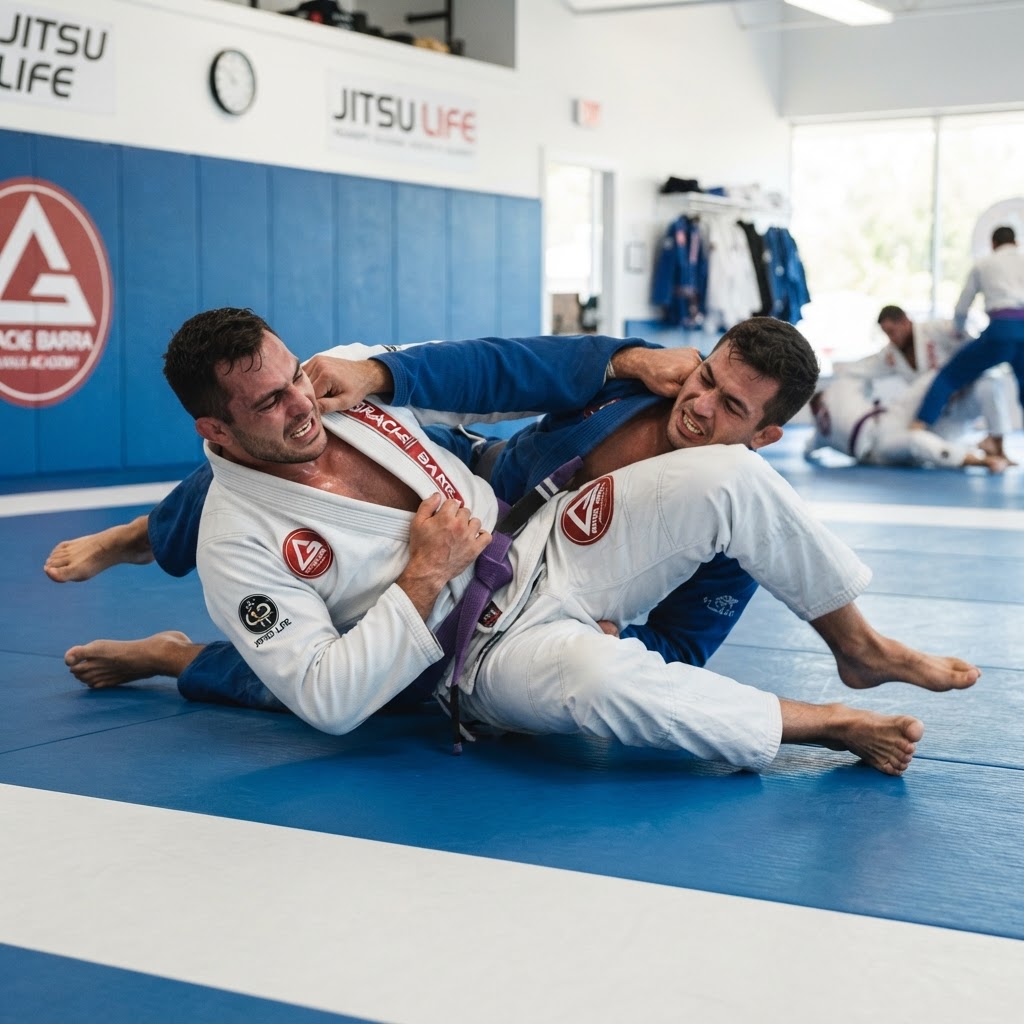
Named after the legendary judoka Masahiko Kimura, the Kimura lock is a shoulder joint lock that applies rotational pressure to the shoulder by isolating the opponent's wrist and leveraging it behind their back using a figure-four grip. The Kimura is one of the most versatile submissions in BJJ — it can be applied from guard, side control, north-south, and even as a counter to your opponent's attacks.
What makes the Kimura special is its dual function as both a submission and a control position. Even if you don't finish the submission, the Kimura grip can be used to sweep, take the back, or transition to other attacks. For grapplers in the Shenandoah Valley looking to build a well-rounded game, the Kimura is an absolute must-learn technique.
Key tips for beginners: Secure a tight figure-four grip on the wrist. Keep your opponent's elbow tight to your body. Apply pressure by rotating their hand toward the back of their head, not by yanking.
5. Guillotine Choke
The guillotine choke is a front choke that attacks the opponent's neck using your arm in a guillotine-like motion — hence the name. It's one of the first submissions many beginners learn because it naturally presents itself when an opponent shoots in for a takedown with poor posture. The guillotine can be applied as both an air choke and a blood choke, depending on the grip and angle.
In both gi and no-gi training, the guillotine is a high-percentage submission that works from standing, from guard, and from front headlock positions. It's especially relevant for students who also have a wrestling background — check out our article on transitioning from wrestling to BJJ for more crossover techniques.
READY TO TRY BRAZILIAN JIU-JITSU?
Claim a FREE trial class at Skyline Jiu-Jitsu today!
Serving Waynesboro, Charlottesville, Fishersville & the Shenandoah Valley
Key tips for beginners: Get a deep grip on the neck — your hand should reach past their chin. Close your elbow tight to your body. Use your other hand to push their head down and to the side for maximum pressure.
6. Americana (Key Lock)
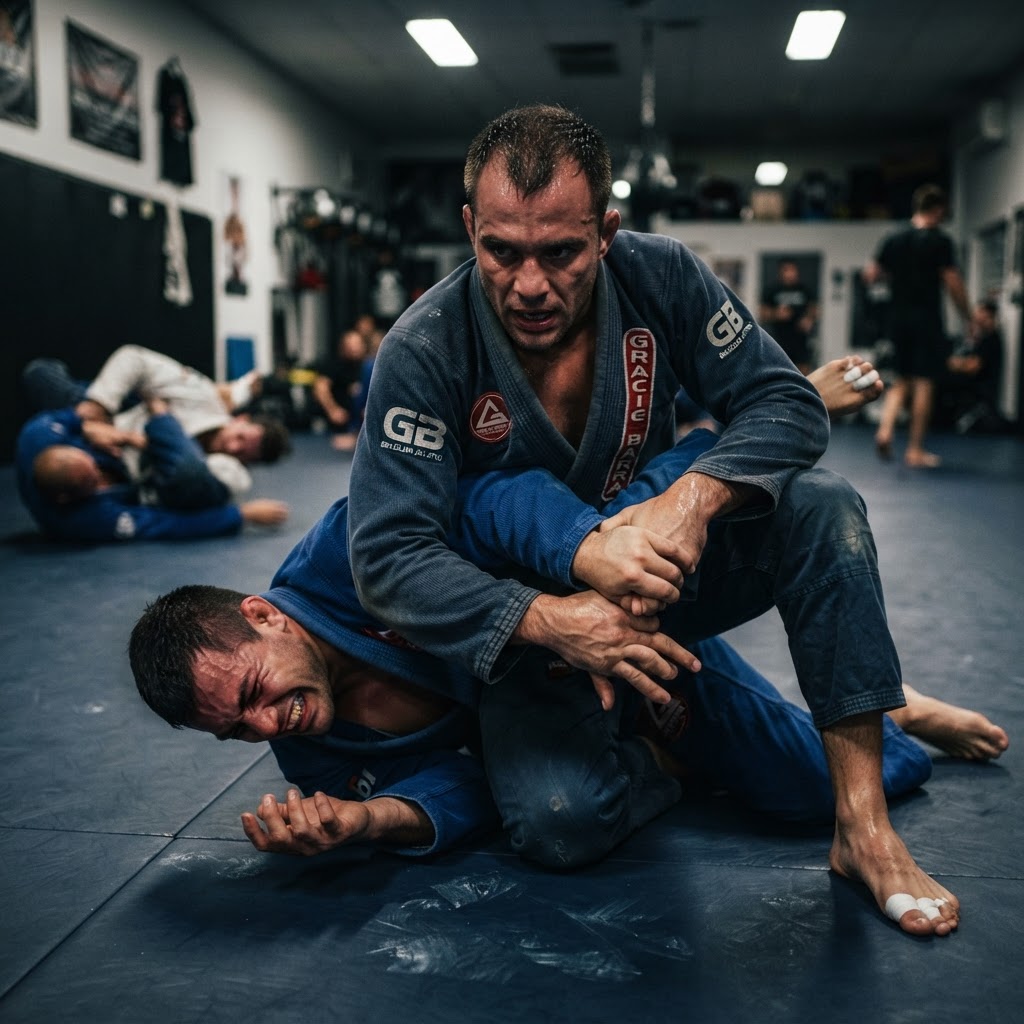
The Americana, also known as the key lock or figure-four armlock, is a shoulder joint lock applied from top positions — most commonly from side control and mount. Unlike the Kimura, which rotates the arm backward, the Americana rotates the arm forward, applying pressure to the shoulder joint in the opposite direction.
While it may seem like a simpler submission, the Americana teaches crucial fundamentals about control and leverage. It's one of the first joint locks taught to white belts because it reinforces the importance of maintaining top position before attacking. At our Waynesboro academy, we frequently use the Americana to teach students how to combine submissions with positional dominance.
Key tips for beginners: Pin the opponent's wrist to the mat with a figure-four grip. Lift their elbow toward the ceiling while keeping their wrist pinned. The pressure should build gradually — never slam the submission.
7. Straight Ankle Lock (Straight Foot Lock)
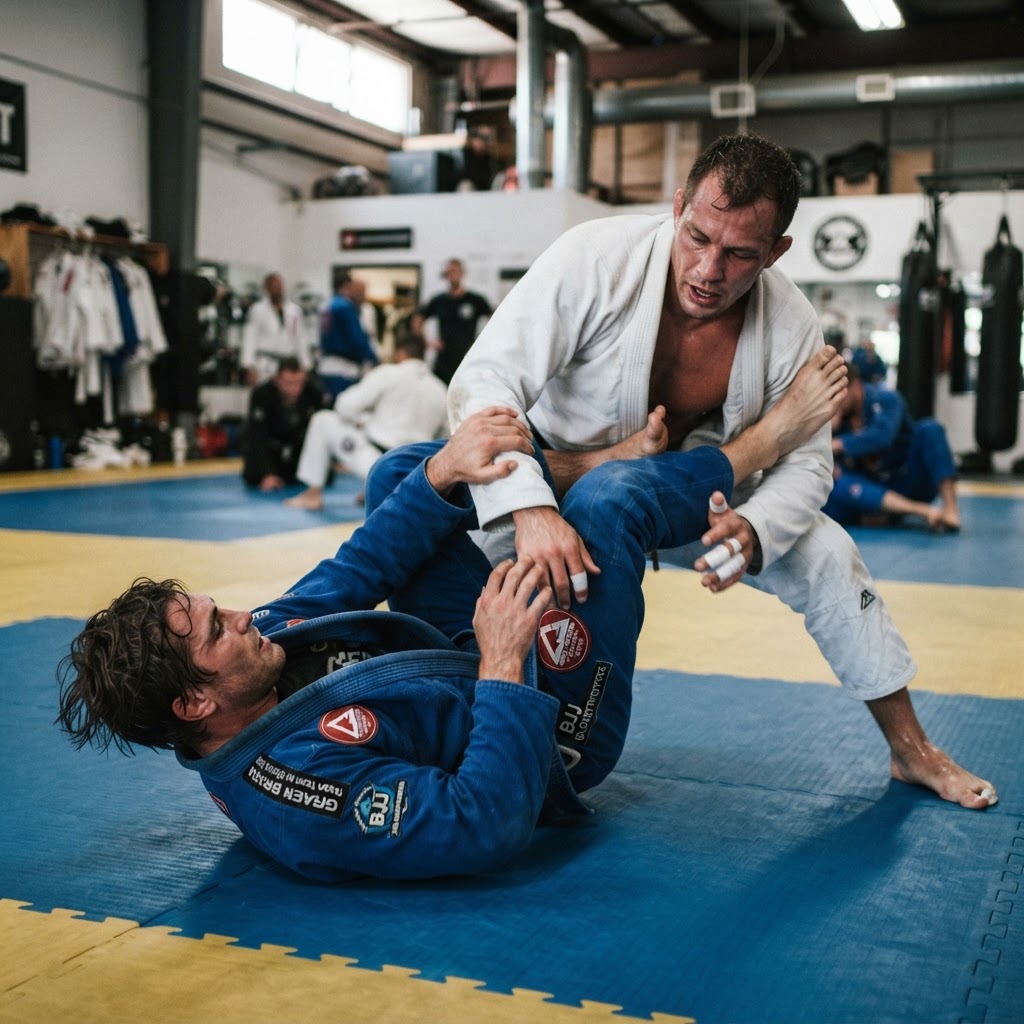
The straight ankle lock is the most fundamental leg submission in BJJ. It attacks the ankle joint by applying pressure with your forearm against the Achilles tendon while controlling the foot with your armpit. Once considered an advanced technique, the ankle lock has become increasingly common at all levels of BJJ competition as leg entanglement knowledge has spread through the art.
For students in Waynesboro and Charlottesville learning BJJ submissions, the ankle lock opens up an entirely new world of lower-body attacks. It teaches you to attack from positions like ashi garami (single leg X) and breaks the tendency to only chase upper-body submissions. As you progress through the BJJ belt system, leg locks become an increasingly important part of your arsenal.
Key tips for beginners: Keep your opponent's foot trapped deep in your armpit. Pinch your knees together to control their leg. Apply pressure by leaning back and rotating your torso, not by yanking with your arms.
How to Train BJJ Submissions Safely
One of the most important aspects of training submissions is learning to apply them safely and responsibly. Brazilian Jiu-Jitsu is called the "gentle art" for a reason — the tap system allows practitioners to train at full intensity without serious injury. Here are some safety principles every grappler in the Shenandoah Valley should follow:
- Always respect the tap: When your partner taps, release the submission immediately. There is no ego in training.
- Apply submissions gradually: Never slam or crank a submission. Apply pressure slowly so your partner has time to tap.
- Tap early, tap often: As a beginner, don't wait until a submission is fully locked in. If you feel caught, tap and reset.
- Communicate with your partner: If something feels dangerous or uncomfortable, speak up. Good training partners appreciate the feedback.
Understanding the history of Brazilian Jiu-Jitsu helps you appreciate why the tap culture is so deeply embedded in the art. From its earliest days, BJJ was designed to be trained safely at full resistance — something that sets it apart from many traditional martial arts.
Building a Submission Game
As you progress in your BJJ journey, you'll begin to develop a personal "submission game" — a set of attacks that work best for your body type, style, and preferences. Some grapplers are choke specialists, others prefer joint locks, and some build their game around leg attacks. There's no right or wrong approach, but there are principles that will help you develop faster:
Master the fundamentals first. The seven submissions covered in this guide account for the vast majority of taps at all levels of BJJ. Before you explore advanced techniques like flying armbars or inverted heel hooks, make sure your rear naked choke, armbar, and triangle are sharp. Fundamentals win at every level.
Chain your submissions. The best submission artists don't just attack single techniques — they chain attacks together. If your armbar fails, transition to a triangle. If the triangle fails, flow to an omoplata. This concept of submission chaining is what separates advanced grapplers from beginners.
Drill, drill, drill. Repetition is the mother of skill. At Skyline Jiu-Jitsu, we incorporate regular drilling into every class to help students build muscle memory. The more you drill a submission, the more instinctive it becomes during live rolling.
Submissions in Gi vs No-Gi
The submissions you favor may change depending on whether you're training in the gi or no-gi. In the gi, collar chokes like the cross choke and bow-and-arrow choke become available, and fabric grips add control to your joint locks. In no-gi, the faster pace and lack of grips means you'll rely more on underhooks, wrist control, and squeeze-based chokes like the D'Arce and anaconda.
Both gi and no-gi have their advantages, and training both will make you a more well-rounded grappler. Read our complete comparison in our guide on gi vs no-gi BJJ differences to understand how submissions change between the two styles.
Start Learning BJJ Submissions in Waynesboro, VA
Whether you live in Waynesboro, Fishersville, Charlottesville, or anywhere in the Shenandoah Valley, Skyline Jiu-Jitsu is your home for learning BJJ submissions in a safe, supportive environment. Our instructors break down every technique step by step, ensuring that beginners can understand and apply submissions from day one. Check our class schedule and pricing options to find a time that works for you.
Related Posts
- BJJ Positions Explained: The Essential Positions Every Student Should Know
- What Is Brazilian Jiu-Jitsu? A Complete Beginner's Guide to the Gentle Art
- BJJ for Beginners: How to Survive Your First Month of Training
- Gi vs No-Gi BJJ: Key Differences and Which Style Is Right for You
- The Complete BJJ Belt System Explained: Timeline, Stripes, and What to Expect
- The History of Brazilian Jiu-Jitsu: From Ancient Japan to Global Phenomenon
READY TO TRY BRAZILIAN JIU-JITSU?
Claim a FREE trial class at Skyline Jiu-Jitsu today!
Serving Waynesboro, Charlottesville, Fishersville & the Shenandoah Valley