BJJ for Wrestlers: Why Crossover Athletes Have the Ultimate Advantage on the Mat
If you've spent years on the wrestling mat, you're sitting on a goldmine of skills that most Brazilian Jiu-Jitsu practitioners would envy. BJJ for wrestlers isn't just a natural transition — it's an unfair advantage. The explosive takedowns, relentless pressure, and mat awareness you've drilled for years transfer directly to the BJJ mats, giving you a head start that takes non-wrestlers years to develop.
Here in Waynesboro, Virginia, and across the Shenandoah Valley, we've seen wrestlers from Charlottesville, Fishersville, and Staunton walk into Skyline Jiu-Jitsu and pick up BJJ faster than almost anyone else. Whether you're a high school wrestler looking for an off-season sport, a college athlete whose competitive career has ended, or just someone who wrestled years ago and misses the grind, Brazilian Jiu-Jitsu is the perfect next step.
In this guide, we'll break down exactly why BJJ for wrestlers is such a powerful combination, what skills carry over, what you need to unlearn, and how to make the transition smooth — especially if you're training in the Waynesboro area.
The Wrestling-to-Jiu-Jitsu Pipeline: Why It Works So Well
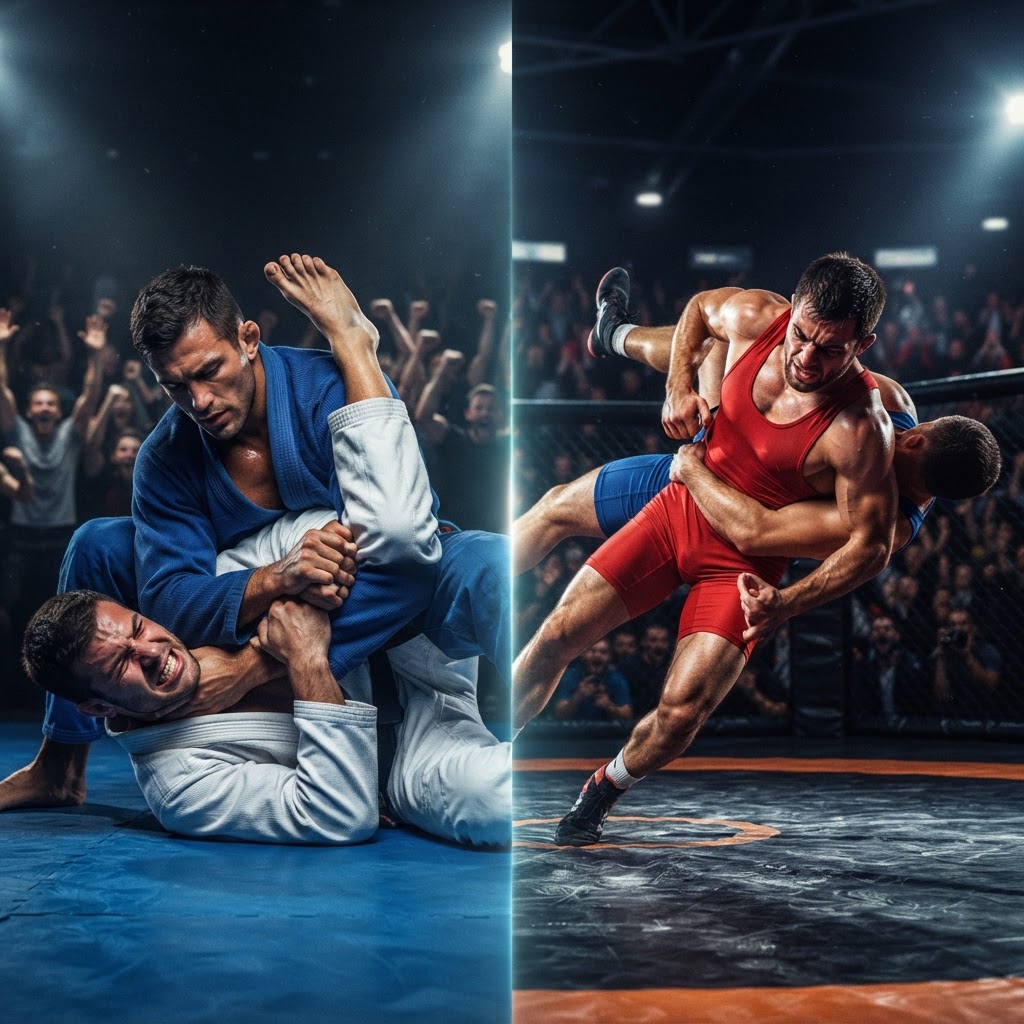
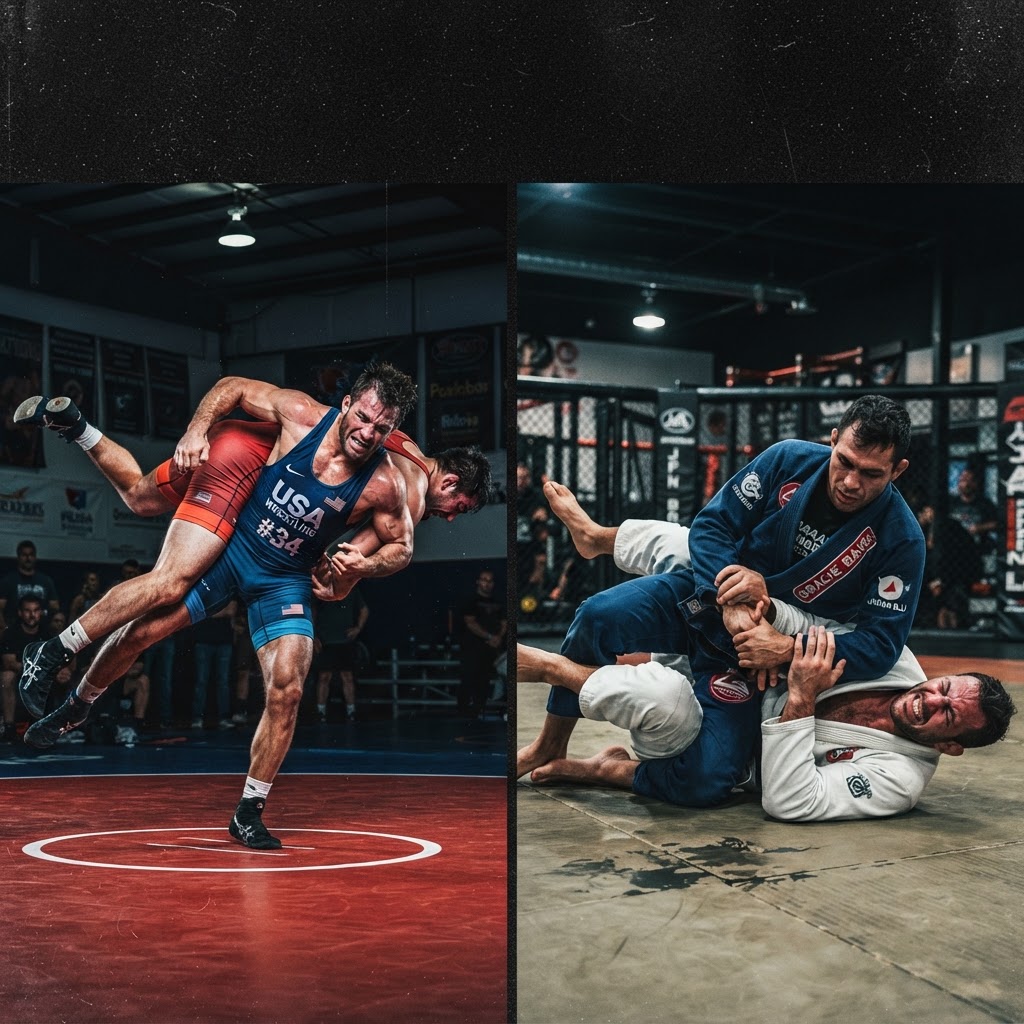
Wrestling and BJJ are both grappling arts, which means the fundamental movements — controlling your opponent's body, establishing dominant positions, and fighting for leverage — are nearly identical. But there's a reason wrestlers consistently dominate when they cross over into jiu-jitsu.
It comes down to three things: pressure, conditioning, and mat sense.
Wrestlers train with a level of intensity that most people don't experience until they've been in BJJ for years. The constant hand-fighting, sprawling, and scrambling builds a kind of physical toughness that's hard to teach from scratch. When a wrestler steps onto the BJJ mat, they bring that intensity with them — and it shows immediately.
The rise of wrestle jitsu — the hybrid style that blends wrestling's takedown and top-pressure game with BJJ's submission arsenal — has changed the competitive landscape. Look at athletes like Bo Nickal, a decorated wrestler who transitioned to MMA and submission grappling. Or Gordon Ryan, who incorporated wrestling-heavy takedown strategies into his no-gi game. The pattern is clear: wrestlers who learn submissions become some of the most dangerous grapplers on the planet.
If you want a deeper comparison of the two sports, check out our guide on BJJ vs Wrestling: Key Differences, Rules, and Which Martial Art Is Right for You.
5 Wrestling Skills That Give You a Head Start in BJJ
1. Takedowns and Stand-Up Game
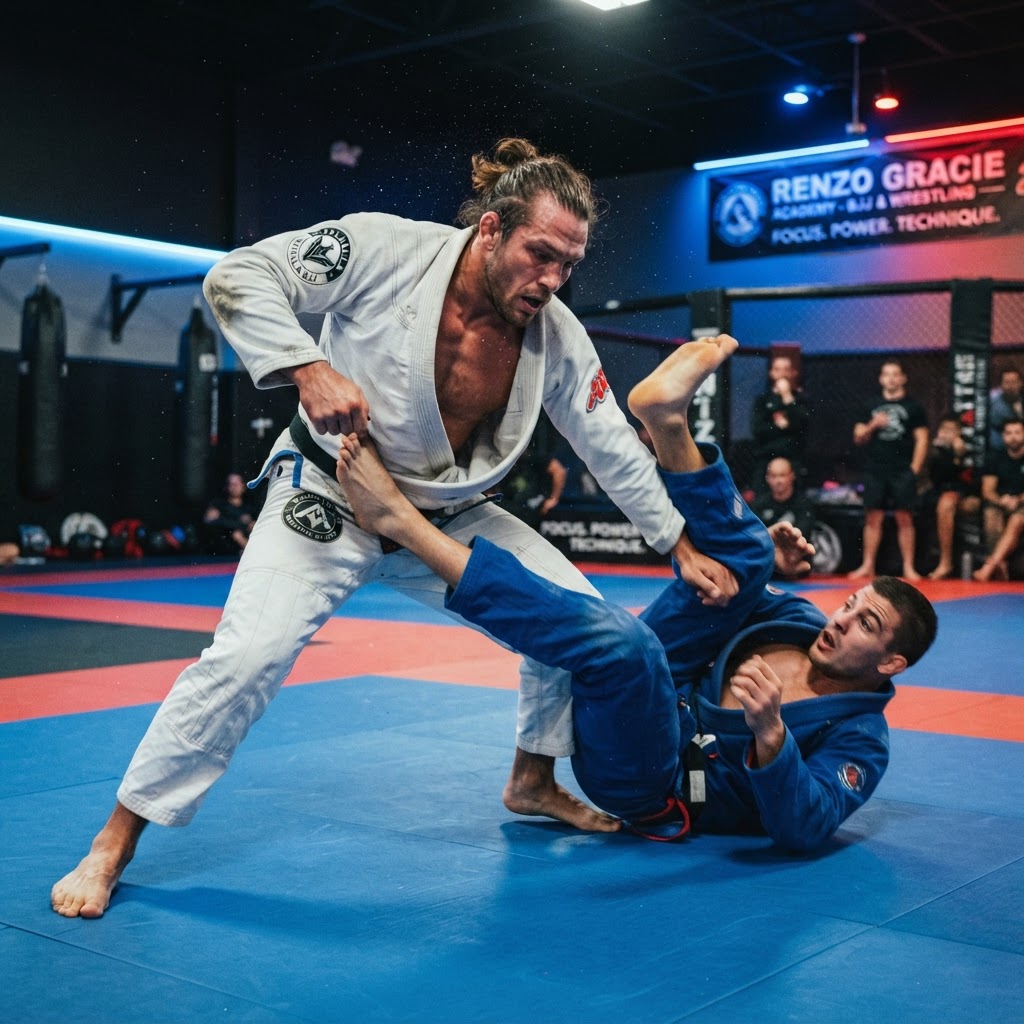
Most BJJ practitioners start training on the ground — pulling guard, working from the bottom, focusing on submissions. But every BJJ match (and every real-world encounter) starts standing up. Wrestlers already have a devastating takedown game. Double legs, single legs, high crotches, and body locks are all legal in BJJ, and most jiu-jitsu practitioners have terrible takedown defense.
This means a wrestler entering BJJ can often dictate where the fight goes. You decide whether the match hits the ground — and where on the ground it goes. That's an enormous advantage. For more on this, read our breakdown of Wrestling Takedowns for BJJ: 7 Stand-Up Skills Every Grappler Should Learn.
2. Top Pressure and Control
Wrestlers live in the top position. Side control, knee-on-belly, and mount feel like home to a wrestler — these are essentially just modified ride positions. The heavy, suffocating pressure that wrestlers apply from the top translates directly to BJJ. A wrestler's side control often feels like a truck parked on your chest.
In BJJ, top pressure isn't just about making your opponent uncomfortable — it sets up submissions. From heavy top control, you can work toward armbars, kimuras, and chokes that a loose, light player would never be able to secure.
3. Scrambling Ability
Wrestling is a sport of constant motion. When a position breaks down, wrestlers don't freeze — they scramble. This instinct is invaluable in BJJ, where scrambles happen constantly. A wrestler who can scramble out of a bad position and reverse into a dominant one will frustrate even advanced BJJ players.
Scrambling is also what makes crossover athletes in BJJ so exciting to watch. They bring a chaos element that pure BJJ players often struggle to handle.
4. Conditioning and Work Ethic
Wrestling conditioning is legendary. The sport demands a level of cardio, strength, and mental toughness that's difficult to replicate. When wrestlers transition to BJJ, they often find the conditioning demands to be manageable — sometimes even refreshing. That base of fitness means you can train harder, recover faster, and push through positions where others gas out.
If you're curious about how BJJ stacks up as a workout, our article Is Jiu Jitsu a Good Workout? breaks down the fitness benefits in detail.
5. Body Awareness and Leverage
Years of wrestling teach you how to feel your opponent's balance, weight distribution, and intentions. This kinesthetic awareness — what wrestlers call "mat sense" — is the same thing BJJ players call "sensitivity." Wrestlers already understand how to use leverage to move a resisting opponent. In BJJ, that understanding accelerates your learning of sweeps, escapes, and submission setups.
What Wrestlers Need to Unlearn When Starting BJJ
While your wrestling background is a massive asset, there are a few habits you'll need to adjust. Cross training wrestling and BJJ means recognizing where the rules diverge.
Stop giving up your back. In wrestling, giving up your back means getting pinned — so wrestlers will do anything to avoid it, including rolling to their stomach. In BJJ, being on your stomach with someone on your back is actually the worst position you can be in. You need to learn to fight to your back or to your knees, not your stomach. This is probably the single biggest adjustment for wrestlers.
Learn to play from the bottom. Wrestling has no bottom game — if you're on the bottom, you're losing. BJJ has an entire world of bottom-position attacks: guard, half guard, deep half, X-guard, and more. Wrestlers often panic when they end up on their backs, but in BJJ, the bottom can be an offensive position. Learning guard is the key that unlocks the rest of your BJJ game.
Slow down and be technical. Wrestling rewards explosion and intensity. BJJ rewards patience and precision. While your conditioning and aggression are assets, you'll progress faster if you learn to slow down, understand the mechanics of each technique, and apply pressure strategically rather than muscling through everything.
READY TO TRY BRAZILIAN JIU-JITSU?
Claim a FREE trial class at Skyline Jiu-Jitsu today!
Serving Waynesboro, Charlottesville, Fishersville & the Shenandoah Valley
For a full walkthrough of making this transition, our guide on How to Transition From Wrestling to BJJ Successfully covers this in depth.
Wrestling Background and BJJ: How Fast Will You Progress?
One of the most common questions wrestlers ask is, "How long will it take me to get good at BJJ?" The answer depends on your wrestling level, but the general rule is: wrestlers progress significantly faster than non-wrestlers.
A high school wrestler with 3-4 years of experience can often reach blue belt in 6-8 months instead of the typical 12-18 months. A college wrestler might do it even faster. The physical base, the mat awareness, and the competitive instincts are all already there — you're just learning a new rule set and adding submissions to your existing grappling vocabulary.
That said, belt progression isn't just about physical ability. Wrestling to jiu jitsu requires learning to think differently about grappling. The BJJ belt system rewards technical understanding, not just athletic dominance. You'll need to show that you can apply techniques with precision, not just power. For more on the ranking system, see our Complete BJJ Belt System Explained.
The Local Scene: Wrestling and BJJ in the Shenandoah Valley
If you're a wrestler in the Waynesboro area, you're in luck. The Shenandoah Valley has a rich wrestling tradition — from youth programs in Fishersville to high school teams in Waynesboro, Staunton, and Charlottesville. Many of these athletes are looking for a way to stay competitive after their wrestling seasons end, and BJJ is the perfect fit.
At Skyline Jiu-Jitsu in Waynesboro, we regularly work with wrestlers from across the region. Our coaching staff understands the wrestling mindset and knows how to channel those skills into BJJ mastery. Whether you're a current high school wrestler looking for off-season training, a former college athlete missing the competition, or a parent whose kid wrestles and wants to try something new, we've got a place for you on the mat.
The beauty of training BJJ in Waynesboro is the community. You're not just joining a gym — you're joining a team of grapplers who push each other to improve. And with easy access from Charlottesville, Fishersville, and Staunton, it's a convenient option for wrestlers across the Shenandoah Valley.
Gi vs No-Gi: Which Should Wrestlers Start With?
Wrestlers often wonder whether to start with gi or no-gi BJJ. The answer is: both, but no-gi will feel more familiar at first.
No-gi BJJ is closer to wrestling — no jacket to grab, more emphasis on underhooks and control, and a faster-paced game. Wrestlers usually feel at home in no-gi immediately. The grips and controls are similar, and your takedown game translates almost 1:1.
Gi BJJ, on the other hand, adds a layer of complexity. The gi gives you and your opponent handles to grab, which changes the grip fighting game entirely. But learning the gi is essential for developing a well-rounded BJJ game — and it will actually improve your no-gi game too by teaching you patience, grip strategy, and submission setups.
Our guide on Gi vs No-Gi BJJ: Key Differences and Which Style Is Right for You covers this in much more detail.
Building Your Submission Arsenal
As a wrestler, you already know how to take people down and control them. What BJJ adds is the ability to finish — submissions. The key submissions every wrestler-turned-BJJ-player should learn first:
- Rear naked choke — the most common submission in BJJ, and one that pairs perfectly with wrestling's back-take ability (once you unlearn the habit of giving up your back)
- Armbar — a versatile submission that can be hit from mount, side control, or guard
- Kimura — a shoulder lock that works great from top positions, which wrestlers naturally favor
- Guillotine choke — perfect for wrestlers, since it can be hit while defending takedowns (something you'll be doing a lot of in BJJ)
- Triangle choke — a submission from guard that teaches wrestlers how to be dangerous from the bottom
For a deeper dive, check out our guide on Essential BJJ Submissions Every Grappler Should Know.
Tips for Your First BJJ Class as a Wrestler
If you're ready to take the plunge, here are a few tips to make your first class go smoothly:
1. Check your ego at the door. You're a great wrestler, but you're a white belt in BJJ. Be ready to tap — a lot. It's part of the process, and there's no shame in it.
2. Don't muscle everything. Your instinct will be to power out of bad positions. Try to resist that urge and focus on learning the technical escape. You'll improve much faster.
3. Tell your instructor about your wrestling background. They'll be able to tailor their instruction to help you bridge the gap between what you know and what you're learning.
4. Embrace the guard. Spending time on your back in guard will feel unnatural, but it's the foundation of BJJ. The sooner you get comfortable there, the faster you'll progress.
5. Have fun. BJJ is an incredible sport that will challenge you in new ways while letting you use the skills you already have. Enjoy the journey.
For more first-class tips, our article BJJ for Beginners: How to Survive Your First Month of Training is a great resource.
Related Posts
- BJJ vs Wrestling: Key Differences, Rules, and Which Martial Art Is Right for You
- Wrestling for BJJ: 7 Ways Wrestling Improves Your Brazilian Jiu-Jitsu
- Wrestling Takedowns for BJJ: 7 Stand-Up Skills Every Grappler Should Learn
- From the Mat to the Mats: How to Transition From Wrestling to BJJ Successfully
- What Is Brazilian Jiu-Jitsu? A Complete Beginner's Guide
- Essential BJJ Submissions Every Grappler Should Know
READY TO TRY BRAZILIAN JIU-JITSU?
Claim a FREE trial class at Skyline Jiu-Jitsu today!
Serving Waynesboro, Charlottesville, Fishersville & the Shenandoah Valley