Back to School Activities for Kids: Why Jiu-Jitsu Builds Confidence and Focus
Choosing the right back to school activities for kids can make the transition from summer to a new school year smoother, healthier, and more exciting. After a relaxed summer schedule, children often need an activity that gives them structure without adding unnecessary pressure. Brazilian Jiu-Jitsu offers a powerful combination of movement, problem-solving, confidence-building, and community for families in Waynesboro, Fishersville, Charlottesville, and throughout the Shenandoah Valley.
At Skyline Jiu-Jitsu in Waynesboro, Virginia, kids learn in a supervised environment where effort matters more than athletic experience. A child does not need to be the strongest, fastest, or most coordinated student in the room. They simply need to be willing to try, listen, and come back. Those small habits can carry from the mat into the classroom, playground, and everyday life.
Why the Back-to-School Transition Can Be Difficult
Summer gives children more freedom, flexibility, and unstructured time. When school starts, they suddenly have to wake up earlier, follow a schedule, manage homework, navigate social situations, and adjust to new expectations. Even children who enjoy school can feel nervous or distracted during the first few weeks.
An after-school activity can provide a dependable anchor. The best activities for kids after school offer physical movement, positive adult mentorship, opportunities to make friends, and a clear path for improvement. Instead of simply filling time between the school bell and dinner, a well-run program helps children practice skills they can use everywhere.
Jiu-Jitsu is especially useful because every class has a predictable rhythm: warm-up, instruction, practice, and controlled problem-solving. Children know what to expect, but they also face small challenges that encourage them to think and adapt.
How Kids Jiu-Jitsu Builds Confidence
Confidence is not something a coach can hand to a child with a speech. It develops when children attempt something difficult, make mistakes, receive guidance, and discover that they can improve. Kids BJJ creates that process in a safe and repeatable way.
Progress is visible
At first, a new student may struggle to remember how to shrimp, bridge, frame, or stand safely. After several classes, those movements begin to feel familiar. A child who once felt unsure may suddenly complete a technique, escape a position, or help a newer teammate. That visible progress creates genuine self-belief.
Children learn to stay calm under pressure
Being stuck underneath a partner can feel uncomfortable at first. Coaches teach students how to breathe, protect themselves, create space, and work through the position step by step. The lesson is not that difficult situations disappear. The lesson is that a child can remain calm and look for a solution.
Success is measured by effort
A healthy kids martial arts program does not define success only by winning. A student may succeed by paying attention, trying a movement again, encouraging a partner, or remembering to tap. This gives children more ways to feel successful, especially when they are still developing physically or socially.
Jiu-Jitsu Helps Children Improve Focus
Parents often search for activities that improve focus and discipline because children spend much of the school day listening, remembering instructions, and shifting between tasks. Jiu-Jitsu reinforces those same skills through movement.
A technique has details: where the hands go, how the hips move, when to create space, and how to finish safely. Students must listen to the coach, watch the demonstration, and then apply the idea with a partner. They also learn to notice what the other person is doing and adjust their response.
This is active concentration rather than passive attention. Kids are not expected to sit still for an hour-long lecture. They are engaged in a physical puzzle that rewards patience and observation. Over time, many students become more comfortable slowing down, listening carefully, and trying again when the first attempt does not work.
Back to School Activities Should Include Physical Exercise
Children need regular movement for physical health, mood, sleep, and energy management. School days can involve long periods of sitting, and homework can make it harder for families to fit exercise into the evening. A consistent martial arts class gives children a fun reason to move.
Jiu-Jitsu develops coordination, balance, mobility, strength, and cardiovascular conditioning. Warm-ups may include running, tumbling, balance drills, technical stand-ups, and movement games. Technique practice builds body awareness, while controlled rounds teach children how to use energy intelligently instead of simply moving as hard as possible.
The goal is not to turn every child into a competitor. It is to help children feel comfortable in their bodies and associate exercise with learning and community. That positive relationship with movement can support healthy habits throughout the school year.
What Children Learn in a Kids Martial Arts Program
When families compare kids martial arts programs, they should look beyond uniforms and impressive demonstrations. The most valuable programs teach practical skills along with character and safety.
- Body control: Students learn how to move safely, maintain balance, and use controlled pressure.
- Problem-solving: Every position presents a question: How do I create space, improve position, or escape?
- Communication: Training partners must listen, cooperate, and stop immediately when someone taps.
- Respect: Students learn to treat coaches, teammates, and opponents with consideration.
- Persistence: Techniques rarely work perfectly the first time, so children practice staying patient.
- Self-awareness: Kids learn to recognize discomfort, manage emotions, and ask for help.
These lessons are useful at school because they help children handle frustration without giving up or reacting impulsively. They also give children a positive structure for practicing responsibility.
READY TO TRY BRAZILIAN JIU-JITSU?
Claim a FREE trial class at Skyline Jiu-Jitsu today!
Serving Waynesboro, Charlottesville, Fishersville & the Shenandoah Valley
Is Jiu-Jitsu Safe for Children?
Safety should be a parent’s first consideration when choosing any contact sport. Brazilian Jiu-Jitsu is a grappling art, but a responsible kids class is built around supervision, control, and clear rules. There are no punches or kicks in standard BJJ instruction. Students learn to tap, release, protect their partners, and follow the coach’s directions.
At a quality academy, coaches match students thoughtfully based on age, size, experience, and temperament. New students should not be thrown into intense sparring with no explanation. They should learn basic movements, practice techniques at an appropriate pace, and gradually become comfortable with controlled resistance.
Parents should look for clean mats, active coaching, age-appropriate instruction, and a culture where children are encouraged rather than embarrassed. You can read more about choosing a program in our guide to jiu jitsu for kids near me.
How BJJ Supports Social Skills and Friendships
The beginning of a school year can bring new classrooms, new teachers, and new classmates. Some children make friends easily, while others need time and a comfortable setting to open up. A kids BJJ class gives students a shared activity and a clear way to interact.
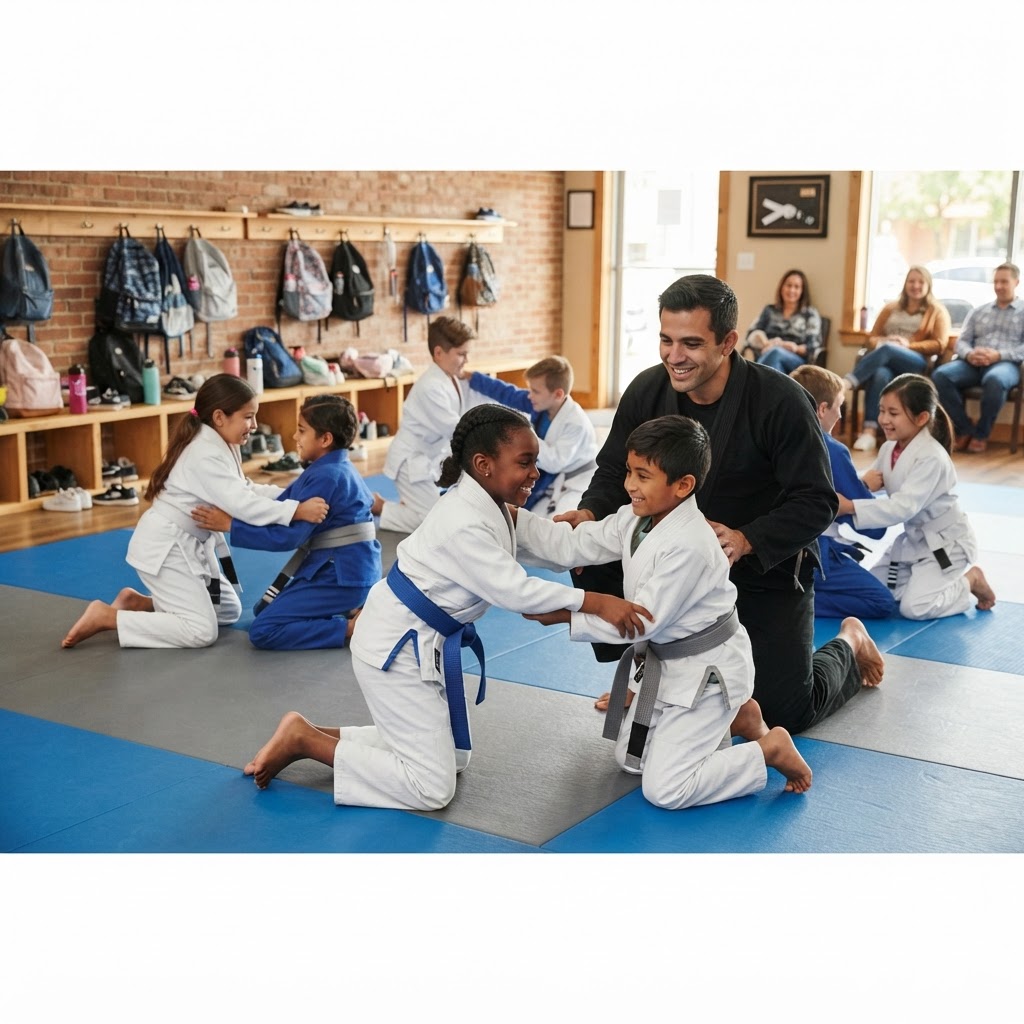
Partners take turns, solve techniques together, and learn how to encourage one another. A child may train with classmates of different ages and skill levels, which teaches flexibility and empathy. Experienced students also get the opportunity to welcome beginners and model good behavior.
Because students work toward personal improvement rather than competing for a starting position, the environment can feel less socially intimidating than some team sports. Children are still part of a community, but they can progress at their own pace.
What to Expect at a Child’s First Class
A first class should be welcoming and organized. Arrive a few minutes early so your child can meet the coach, see the training space, and ask questions before the activity begins. Comfortable athletic clothes are usually appropriate for a trial class, although Skyline Jiu-Jitsu can explain uniform requirements.
The class may begin with movement games or a warm-up. The instructor will then demonstrate a basic skill, such as a safe technical stand-up, a simple escape, or a way to control space. Students practice with partners while the coach circulates and provides feedback. Depending on age and readiness, the class may finish with a controlled game or positional exercise.
Your child does not need to remember everything on day one. The first goal is to become comfortable, listen to the coach, and leave with a positive experience. Nervousness is normal, and a good instructor knows how to help a new student participate without forcing them into situations they are not ready for.
Choosing After-School Activities in Waynesboro and the Shenandoah Valley
For families in Waynesboro, Fishersville, and nearby Charlottesville, convenience matters. The best activity is one your family can attend consistently. Before enrolling, consider the drive, class schedule, age groups, communication from the academy, and whether the program offers a trial class.
It is also worth visiting in person. Watch how coaches talk to children. Do they correct mistakes calmly? Do students appear engaged? Are the rules clear? Does the environment feel organized and welcoming? These details tell you more than a stock photo or a list of trophies.
Skyline Jiu-Jitsu serves families across the Shenandoah Valley with classes designed for students at different experience levels. Review the class schedule and pricing options to find a starting point that fits your family’s routine.
Making Jiu-Jitsu Part of the School-Year Routine
Consistency is more important than doing everything at once. Start with one or two classes each week and make the routine predictable. Pack the gear in advance, keep water available, and allow enough time to get to the academy without rushing. A calm routine helps children view practice as a normal and enjoyable part of the week.
Parents can reinforce progress by asking what their child learned rather than only asking whether they won. Questions such as “What was challenging?” “What did you practice?” and “Did you help your partner?” encourage reflection and reinforce the values behind martial arts.
Some weeks will be busy. Homework, sports, illness, and family commitments happen. The goal is not perfection; it is returning to the routine and continuing to learn. That mindset is one of the most valuable back-to-school lessons of all.
Final Thoughts for Parents
The best back to school activities for kids do more than occupy free time. They help children become healthier, more confident, more focused, and better prepared to handle challenges. Brazilian Jiu-Jitsu combines physical exercise with cooperation, discipline, and practical problem-solving, making it a strong choice for families seeking a meaningful after-school activity.
Whether your child is outgoing, shy, athletic, brand new to sports, or simply looking for a fresh challenge, the right BJJ program can provide a supportive place to grow. Skyline Jiu-Jitsu welcomes families from Waynesboro, Fishersville, Charlottesville, and the surrounding Shenandoah Valley. Start the school year with one small step onto the mat.
Related Posts
READY TO TRY BRAZILIAN JIU-JITSU?
Claim a FREE trial class at Skyline Jiu-Jitsu today!
Serving Waynesboro, Charlottesville, Fishersville & the Shenandoah Valley