# BJJ for Depression: How Brazilian Jiu-Jitsu Lifts Your Mood and Builds Emotional Resilience
If you've been searching for a natural way to manage depression, **BJJ for depression** is gaining serious attention from researchers, therapists, and practitioners alike. Brazilian Jiu-Jitsu offers a powerful combination of physical exertion, social connection, and problem-solving that can help lift your mood and build the emotional resilience needed to navigate life's toughest moments. Whether you're in Waynesboro, Charlottesville, Fishersville, or anywhere in the Shenandoah Valley, stepping onto the mats at Skyline Jiu-Jitsu could be the first step toward feeling like yourself again.
Depression affects more than 21 million adults in the United States, and many people are looking for complementary approaches that go beyond medication and traditional therapy. While Brazilian Jiu-Jitsu is not a replacement for professional mental health treatment, the research and real-world experiences are showing that it can be a powerful tool in your mental wellness toolkit.
## The Science Behind BJJ for Depression
### Endorphins and the Brain's Natural Mood Boosters
Every time you step on the mat, you're engaging in intense physical activity that triggers a cascade of neurochemical changes. Your brain releases endorphins, serotonin, and dopamine, the body's natural mood elevators. A single BJJ session can elevate these neurotransmitters for hours afterward, creating what practitioners often call the "post-roll glow."
But the benefits go deeper than a temporary endorphin rush. Research shows that Brazilian Jiu-Jitsu training increases brain-derived neurotrophic factor (BDNF), a protein linked to better mood, clearer thinking, and reduced risk of neurodegenerative diseases. Higher BDNF levels are associated with improved cognitive function and emotional regulation, two areas that depression often disrupts.
### A 2025 Study on BJJ and Mental Health
A landmark 2025 study published in Frontiers in Sports and Active Living examined 420 Brazilian Jiu-Jitsu athletes and found that those with higher self-control, life satisfaction, and resilience presented significantly better mental health profiles. The study confirmed that BJJ athletes who trained consistently showed lower rates of mental health disorders compared to the general population.
The researchers also found that BJJ black belts demonstrated significantly higher mental strength, resilience, self-efficacy, and life satisfaction than white belts, suggesting that the longer you train, the more profound the mental health benefits become.
## 5 Ways BJJ Helps Fight Depression
### 1. Physical Activity That Actually Feels Like Play
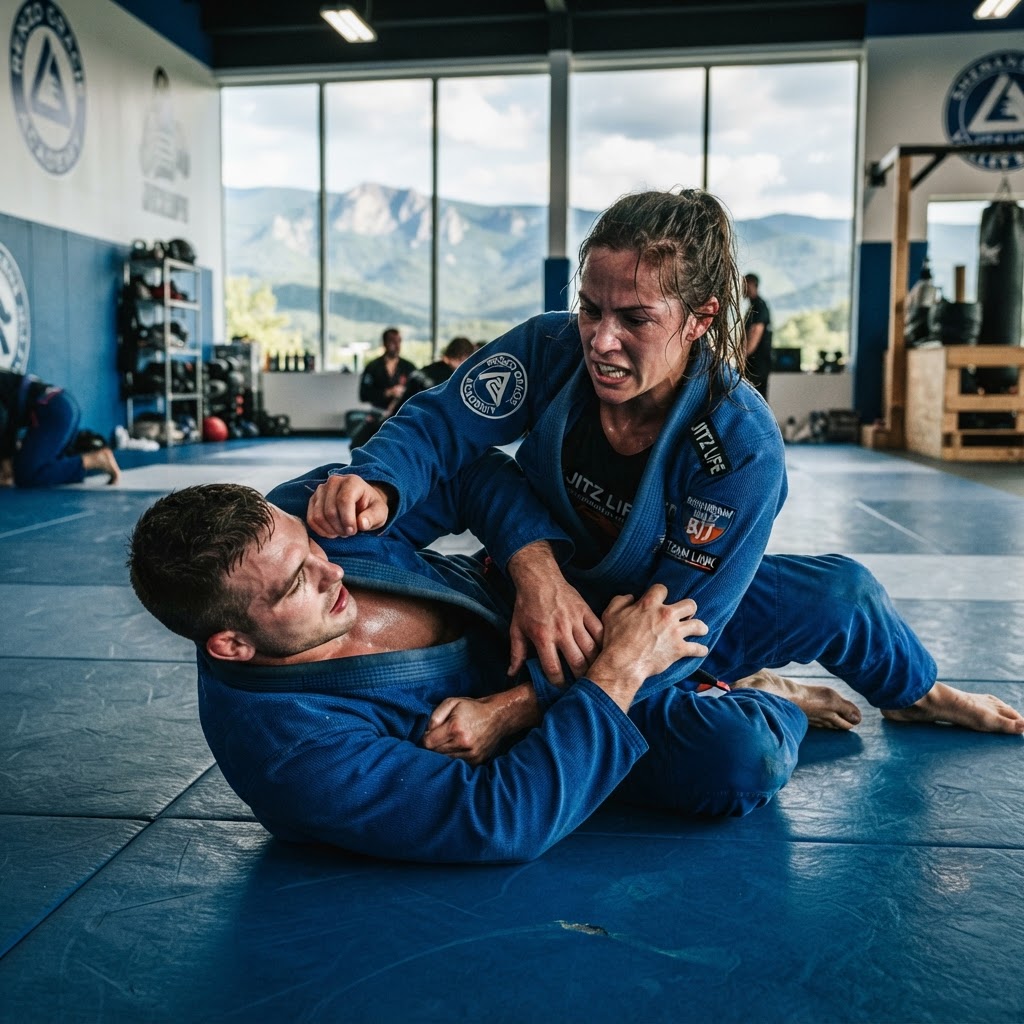
One of the hardest parts of managing depression is finding the motivation to exercise. Traditional gym routines can feel monotonous and isolating. BJJ flips that script entirely. When you're rolling, you're not thinking about reps or sets. You're solving a physical puzzle in real time. Your training partner is resisting, countering, and challenging you, and your mind is fully engaged in the present moment.
This is what makes jiu jitsu for mental health so effective: it combines the proven mood-boosting effects of exercise with the engagement of play and problem-solving. You're not grinding through a workout. You're learning, adapting, and growing with every session.
### 2. The Power of Physical Touch and Human Connection
Depression often comes with social withdrawal and a sense of isolation. BJJ is inherently social and involves safe, structured physical contact. Drilling techniques, rolling with partners, and helping teammates learn creates a bond that's hard to replicate in any other setting.
The BJJ community at Skyline Jiu-Jitsu in Waynesboro is built on mutual respect and shared struggle. When you tap someone and they tap you back, when you celebrate a promotion together, when you commiserate over a tough round, you're building relationships that combat the isolation depression thrives on.
Research from the journal Jiu-Jitsu and Society found that the social interactions within the BJJ community serve as a "protective buffer against mental health disorders," providing men and women of all ages with a path to improved mental wellbeing through shared experience.
### 3. Mindfulness in Motion
Depression often pulls you into rumination, replaying negative thoughts and worrying about the future. On the mat, there's no room for that. When someone is trying to pass your guard or set up a submission, your full attention is required. This forced present-moment awareness is a form of mindfulness that many practitioners describe as "moving meditation."
Unlike seated meditation, which can be difficult for someone in a depressive episode, BJJ gives you something to do with your body while your mind settles. The physical intensity demands your attention, pulling you out of your head and into your body. This BJJ stress relief effect is both immediate and cumulative. The more you train, the better you become at staying present under pressure, both on and off the mats.
### 4. Building Self-Efficacy Through Tangible Progress
Depression erodes your sense of competence and self-worth. BJJ rebuilds it through measurable, tangible progress. Every stripe on your belt, every technique you master, every training partner you can finally hold your own against, these are concrete proof that you're growing and improving.
A study of rank-based psychological characteristics in BJJ athletes found that more experienced practitioners showed higher self-efficacy and life satisfaction. The belt system gives you a clear progression path, and the skills you develop are undeniable. You can feel the difference between where you started and where you are now.
If you've been struggling with confidence alongside depression, our article on [how jiu jitsu builds confidence](https://www.skylinejiujitsu.com/blog/how-jiu-jitsu-builds-confidence) goes deeper into the science behind this transformation.
### 5. Routine and Structure When You Need It Most
Depression often disrupts daily routines, making it hard to maintain healthy habits. BJJ training provides structure. When you commit to showing up two or three times a week, you're building a framework around which the rest of your day can organize itself.
At Skyline Jiu-Jitsu, our class schedule in Waynesboro is designed to fit into your life, whether you're an early riser or prefer evening sessions. That consistency becomes an anchor. Even on days when depression makes everything feel heavy, knowing your training partners are expecting you can be the push you need to get out of the house and onto the mats.
## Why BJJ Works When Other Workouts Fall Short
You might wonder why BJJ specifically helps with depression when running, lifting, or cycling might not have the same effect. The answer lies in what researchers call the "physical-mental-social model" of BJJ.
A study from Auburn University's Military REACH program examined BJJ's impact on veterans managing PTSD and depression, finding that the sport engaged three critical elements simultaneously: physical exertion, mental challenge, and social connection. No other form of exercise hits all three at the same time and at the same intensity.
Running gives you the physical benefits but lacks the social interaction and mental challenge. Weightlifting provides physical and mental engagement but is often a solitary activity. BJJ demands all three simultaneously, which is why it can produce results that other workouts cannot.
## BJJ for Depression: What to Expect at Skyline Jiu-Jitsu
If you're in Waynesboro, Charlottesville, Fishersville, or the surrounding Shenandoah Valley, Skyline Jiu-Jitsu offers a welcoming environment for beginners, including those who are dealing with depression or other mental health challenges.
### A Supportive First Class Experience
Your first class won't involve sparring or anything overwhelming. You'll learn fundamental movements, drill basic techniques with a partner, and get a feel for the art in a controlled, supportive environment. Our instructors understand that everyone walks through the door carrying something, and they're trained to meet you where you are.
If you're nervous about your first session, check out our guide on [what to expect at your first BJJ class](https://www.skylinejiujitsu.com/blog/what-to-expect-at-your-first-bjj-class) to ease your mind.
### A Community That Has Your Back
One of the most powerful antidotes to depression is connection, and the community at Skyline Jiu-Jitsu is built on it. Our members range from high school students to retirees, from law enforcement officers to teachers to stay-at-home parents. What unites them is the shared experience of growth and the bonds forged on the mat.
You can learn more about our [class schedule and pricing](https://www.skylinejiujitsu.com) to find a time that works for you.
## Complementing, Not Replacing, Professional Treatment
It's important to be clear: Brazilian Jiu-Jitsu is not a substitute for professional mental health treatment. If you're experiencing depression, we strongly encourage you to work with a qualified therapist or psychiatrist. BJJ is a complement to that care, a powerful tool that can enhance the work you're doing in therapy and amplify the benefits of any treatment plan.
Many practitioners find that the confidence, routine, and community they build through BJJ make them more engaged in their therapy and more committed to their overall mental health journey. The physical activity improves sleep, reduces anxiety, and provides a sense of accomplishment that makes the harder days more manageable.
## Real Results from Real People
Across the BJJ community, practitioners consistently report that training has transformed their relationship with depression. They describe feeling more present, more connected, and more in control of their emotions. They talk about the relief of having something to look forward to, the pride of tangible progress, and the comfort of knowing they're not alone.
Research backs this up. The 2025 study of 420 BJJ athletes found that life satisfaction was a significant predictor of better mental health outcomes for both male and female practitioners. And a study from the University of South Florida highlighted BJJ's benefits for individuals managing PTSD, including improvements in depressive symptoms, anxiety, and overall quality of life.
## Getting Started: Your First Step Toward Feeling Better
Depression can make everything feel impossible, including starting something new. But the beauty of BJJ is that you don't need to be in shape, athletic, or confident to begin. You just need to show up.
At Skyline Jiu-Jitsu in Waynesboro, we offer a free trial class so you can experience the mat without any pressure or commitment. Come see for yourself why so many people in the Shenandoah Valley have found that BJJ for depression is more than just exercise. It's a lifeline.
## Related Posts
- [BJJ for Anxiety: How Brazilian Jiu-Jitsu Calms the Mind and Builds Resilience](https://www.skylinejiujitsu.com/blog/bjj-for-anxiety-mental-health)
- [BJJ Mental Health Benefits: How Brazilian Jiu-Jitsu Reduces Stress and Builds Confidence](https://www.skylinejiujitsu.com/blog/bjj-mental-health-benefits-stress-confidence)
- [How Jiu Jitsu Builds Confidence: The Science-Backed Guide to Self-Esteem Through BJJ](https://www.skylinejiujitsu.com/blog/how-jiu-jitsu-builds-confidence)
- [BJJ for Weight Loss: How Brazilian Jiu-Jitsu Transforms Your Body and Burns Fat](https://www.skylinejiujitsu.com/blog/bjj-for-weight-loss)
- [Is Jiu Jitsu a Good Workout? The Complete Guide to BJJ Fitness Benefits](https://www.skylinejiujitsu.com/blog/is-jiu-jitsu-a-good-workout)
START TRAINING TODAY
READY TO TRY BRAZILIAN JIU-JITSU?
Claim a FREE trial class at Skyline Jiu-Jitsu today!
Serving Waynesboro, Charlottesville, Fishersville & the Shenandoah Valley
Start Training Today
READY TO TRY BRAZILIAN JIU-JITSU?
Claim a FREE trial class at Skyline Jiu-Jitsu today!
Serving Waynesboro, Charlottesville, Fishersville & the Shenandoah Valley